USAID DEC
Responsive Economic Assistance to Conflict-affected Households (REACH) FY15 Q2 Quarterly Report
Sign inICRC
Responsive Economic Assistance to Conflict-affected Households (REACH) FY15 Q2 Quarterly Report
The Responsive Economic Assistance to Conflict-affected Households (REACH) project is a USAID/ Food for Peace (FFP) funded initiative aimed at providing food assistance to conflict-affected households in northeastern Nigeria.
2015 · 12 pages
Sign in to readA free account is required to download.
Abstract
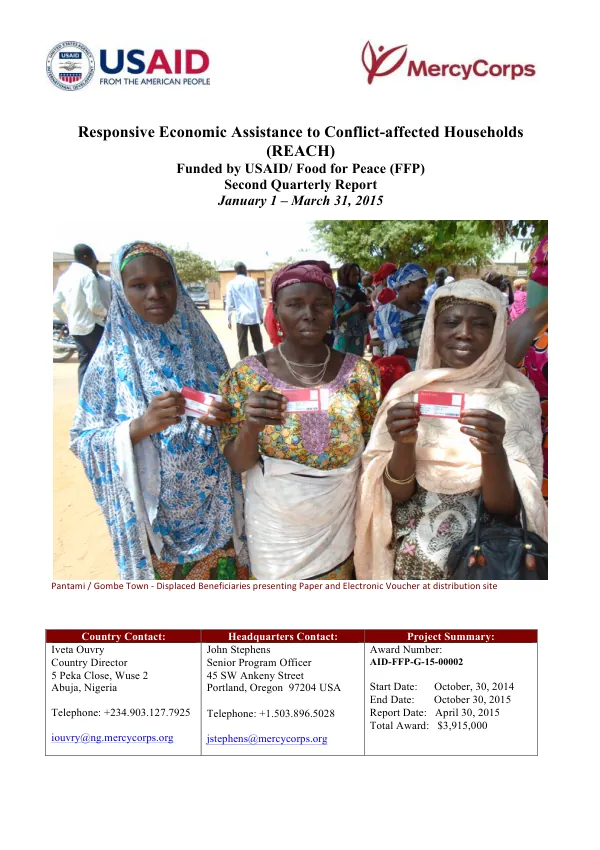
The project is being implemented in Gombe State, where a significant number of people have been displaced due to the Boko Haram insurgency. The project targets 28,700 individuals on a monthly basis for a duration of 9 months, with the goal of improving their access to basic food commodities. The project is being implemented in parallel with an OFDA-funded Non-Food Item (NFI) and livelihoods support project in the same geographical area. The REACH project focuses on providing food assistance through monthly voucher-based distributions, while the OFDA project targets the same communities with NFI and livelihoods support. By providing comprehensive assistance to the targeted communities, Mercy Corps aims to have a higher impact on families. During the second quarter of 2015, the major activities conducted for the REACH project included the registration of more beneficiaries, conducting baseline surveys, and producing the baseline report. The project also trained vendors and beneficiaries on the use of smart cards and electronic terminals, and distributed credit through electronic vouchers for two rounds of food basket distributions. Additionally, the project conducted needs assessments for voucher-for-work activities and sensitized communities for a nutritional campaign. The security situation in Gombe State remained tense during the reporting period, with incidents relating to the insurgency and the elections contributing to a slow-down in program activities. The attack by Boko Haram insurgents on February 14th in Gombe and Dadin Kowa towns slowed down most program activities and prevented active monitoring of paper voucher transactions in some of the communities of intervention. The security situation also restricted Mercy Corps movement to Funakaye LGA due to constant raids on some of the communities there. Despite the tenuous security situation, the town of Gombe is still considered relatively safe and continues to receive newly displaced families running away from areas under the control of Boko Haram or being re-displaced within the state. The IDP camp in Gombe was closed down, and the 300 or so families were forced to vacate with modest cash handouts provided to seek alternative accommodation among host communities. Reports from SEMA and community volunteers show that there is still a high influx of IDPs within the communities and other parts of the state. Markets in Gombe State experienced price increases for imported commodities like blankets, soap, and body cream, as well as food such as foreign rice and pasta. The fall of the Naira against the US dollar contributed to higher than usual increases, compounded by inflation which has risen to 8.5%. The exchange rate was 185 NGN/1 USD in the beginning of the quarter and 197 NGN/1 USD at its end. There has also been a noticeable and rapid price increase for locally produced food and non-food items during the quarter under review. Mercy Corps has a fully operational office in Gombe State, with a highly committed team working closely together. The team consists of 19 nationals and one international staff member, with all personnel and support costs being shared between OFDA and FFP. The project has also ensured effective coordination with SEMA, NEMA, the Ministry of Animal Husbandry, and other stakeholders through meetings and the monthly submission of reports. A memorandum of understanding was signed in early February with SEMA, and Mercy Corps has been holding regular bi-lateral meetings with other agencies implementing programs or setting up offices during the last quarter. The project has continued with beneficiary registration to meet the project's targets, with the registration process outlined in the previous quarterly report. The project has also trained vendors and beneficiaries on the use of smart cards and electronic terminals, and distributed credit through electronic vouchers for two rounds of food basket distributions. The project's performance is being closely monitored, with regular assessments and evaluations conducted to ensure that the project is meeting its objectives.