USAID DEC
Emergency Assistance to Conflict Affected Populations (EACAP) FY16 Q2 Quarterly Report
Sign inMERCY CORPS INTERNATIONAL
Emergency Assistance to Conflict Affected Populations (EACAP) FY16 Q2 Quarterly Report
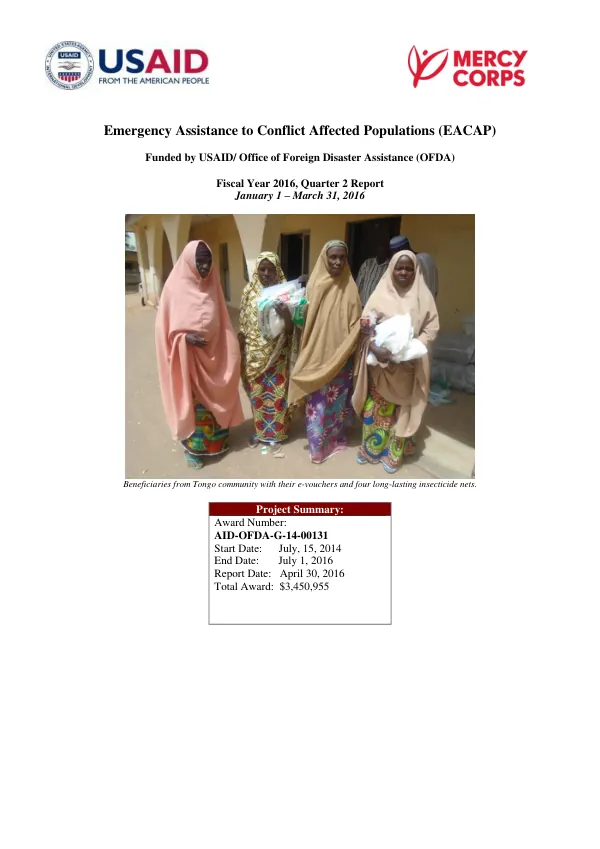
The Emergency Assistance to Conflict Affected Populations (EACAP) program, funded by USAID/Office of Foreign Disaster Assistance (OFDA), aims to respond to the humanitarian needs of conflict-affected communities in Gombe State, Nigeria.
2016 · 12 pages
Sign in to readA free account is required to download.
Abstract
The program, which began in July 2014 and ended in July 2016, was implemented by Mercy Corps and aimed to benefit 100,874 individuals, including 72,975 internally displaced persons (IDPs) and 28,000 vulnerable host community members. The ongoing humanitarian insecurity in northeast Nigeria, caused by Boko Haram and the counter-insurgency, has created a massive displacement crisis, with 14.8 million people affected, including 7 million in need of humanitarian assistance. The conflict has disrupted livelihoods and limited access to markets and agricultural land, leading to a reliance on negative coping strategies by host communities. The EACAP program focused on providing resources to meet immediate needs and sustain local markets, including livelihood grants, Village Savings and Loans (VSLA) groups, and provision of household commodities. The program also aimed to reconstitute productive assets for agricultural production, provide vulnerable households with essential non-food items, and strengthen humanitarian space in Nigeria by building the capacity of local humanitarian workers. During the quarter under review, the program continued to deliver assistance to displaced households and host communities, with 468 livelihoods grants totaling 8,589,289 NGN disbursed and 5 additional VSLA groups mobilized. The program also conducted a joint assessment with the Women Refugee Commission (WRC) to pilot the I'm Here/Girls Roster tool in Adamawa, Borno, and Gombe states. The security context in Gombe State saw a relative improvement during the quarter, with several incidents involving Fulani herdsman occurring, including the kidnapping of a school-age girl. However, the Nigerian army made progress against Boko Haram in areas of Borno State through airstrikes and ground offensives. The region remains a significant threat, with suicide bombings and other violent attacks by suspected Boko Haram members continuing. Population movements were recorded within the quarter in Gombe State, with male heads of household attempting to acquire livelihood opportunities outside the state, leaving behind women and children to fend for themselves. However, the movement was not sustained, and the majority returned to their location of displacement. The closure of markets in Borno and Yobe states by the authorities to mitigate potential financial advantages to Boko Haram, alongside other factors such as border closures and a drop in cereal supply, has pushed up food prices in the region. Given the relatively stable security situation in Gombe, basic commodities remain available in local markets, but the impact of the increase in market prices following the devaluation of the Naira is being felt in the communities of the North-East. Mercy Corps staff coordinated with WFP to carry out a regional market assessment in February, which assessed the market situation of the ongoing crisis and subsequent market disruptions, comparing findings to previous market data. The main focus was on the cereal, fish, and livestock sectors, with preliminary results released in March 2016. During the quarter, Gombe-based teams continued to support vulnerable households through food e-vouchers, NFI e-vouchers, and livelihood grants, as well as conducting training on GBV and protection topics and working with communities to develop proposals for additional CFW projects. Mercy Corps also scaled up support to vulnerable IDP and host-community households through unconditional cash transfers, water point rehabilitation, and protection interventions in Adamawa State.