FHI360
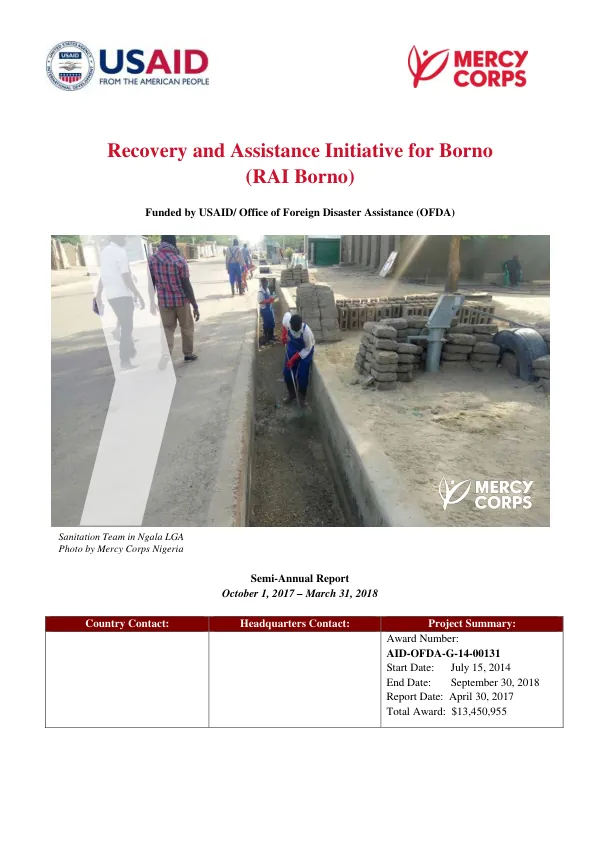
Recovery and Assistance Initiative for Borno (RAI Borno) Semi-Annual Report
The humanitarian crisis in North East Nigeria caused by Boko Haram and the corresponding counter insurgency continues to create a massive need for urgent humanitarian response.
2018 · 22 pages
Sign in to readA free account is required to download.
Abstract
According to the most recently published figures, 14.8 million people across Borno, Adamawa, and Yobe States are affected by the crisis. Of these, an estimated 8.5 million people are currently in need of humanitarian assistance. This includes both displaced and host community members, including those confined or restricted by insurgents and the Nigerian Armed Forces. The massive displacement has led to the disruption of livelihoods and a lack of access to markets. Poor host communities have been sharing resources with one of the largest internally displaced person (IDP) populations in the world and are now relying on negative coping strategies to survive after their savings and assets have been depleted. The Recovery and Assistance Initiative for Borno (RAI Borno) program, implemented by Mercy Corps, aims to meet the humanitarian needs of conflict-affected populations in Borno and Gombe States, restoring their food security and access to livelihood opportunities with safety and dignity. RAI Borno is an expansion of SUBERA 2, which itself was an expansion of Emergency Assistance to Conflict Affected Populations (EACAP), which was an expansion of Strengthening Opportunities and Access to Resilience (SOAR). The program has cumulatively targeted 233,010 individuals, of which 191,992 are IDPs, between July 2014 and September 2018. The program's interventions include livelihoods recovery, provision of non-food items (NFI), protection training, access to water, sanitation, and hygiene (WASH), and emergency shelter for vulnerable families. During the reporting period, RAI Borno's operating areas saw significant activity carried out by Armed Opposition Groups (AOGs). The most significant incident was the attack on the market in Biu, Biu Local Government Area (LGA) on December 2nd, which resulted in the deaths of 23 civilians. Mercy Corps has been working with communities in Biu since the spring of 2016 and has a ban on all road movements to and from Damboa, relying instead on UNHAS helicopter flights from Maiduguri. The attack on Biu market led to the imposition of a curfew by the military in Biu, but this has since been lifted and the situation in Biu has returned to normalcy. The reporting period also saw significant AOG activity on the road between Biu and Damboa, including an attack on a civilian convoy escorted by security forces on February 26th. In Damboa, the military conducted operations, leading to the temporary closure of all roads leading to/from Damboa for all civilian vehicles. In Dikwa, carriers of PBIEDs managed to infiltrate the town and attack the Police Office on both January 20 and January 27, highlighting that the perimeter around Dikwa town could be breached by AOGs. Population movements have been affected, with the residents of Biu IDP Camp A facing relocation to Damboa due to the association between the Kanuri residents of Camp A and Boko Haram. Mercy Corps is coordinating with other humanitarian actors in Damboa to ensure that proper facilities will be available for the relocated residents. Operations in Damboa have faced challenges, including access and fuel issues. While Mercy Corps continues to rely on UNHAS' helicopter service to safely access Damboa, this became difficult due to decreased visibility and damage to the helicopter landing pad. A sandstorm led to decreased visibility in many parts of Nigeria, and UNHAS helicopter flights were cancelled as a result. The helicopter landing pad in Damboa was also in a state of disrepair, leading to UNHAS stopping flights until the pad could be repaired. A further challenge was the embargo on fuel imports into Damboa, which lasted for three weeks and limited the importation of fuel to Maiduguri only. Mercy Corps is procuring solar panels for the office in Damboa to reduce its reliance on fuel. Despite these challenges, RAI Borno's operations in Damboa have continued to advance, with a full-time Field Office Manager and program, operations, and finance staff.