USAID DEC
Emergency Food Security for Flood-Affected Populations in Odisha Baseline Survey Report
Sign inMERCY CORPS INTERNATIONAL
Emergency Food Security for Flood-Affected Populations in Odisha Baseline Survey Report
The Food Security for Flood-Affected Populations in Odisha program is a response to the flooding in the districts of Mayurbhanj and Balasore that followed Cyclone Phailin in October 2013.
2014 · 22 pages
Sign in to readA free account is required to download.
Abstract
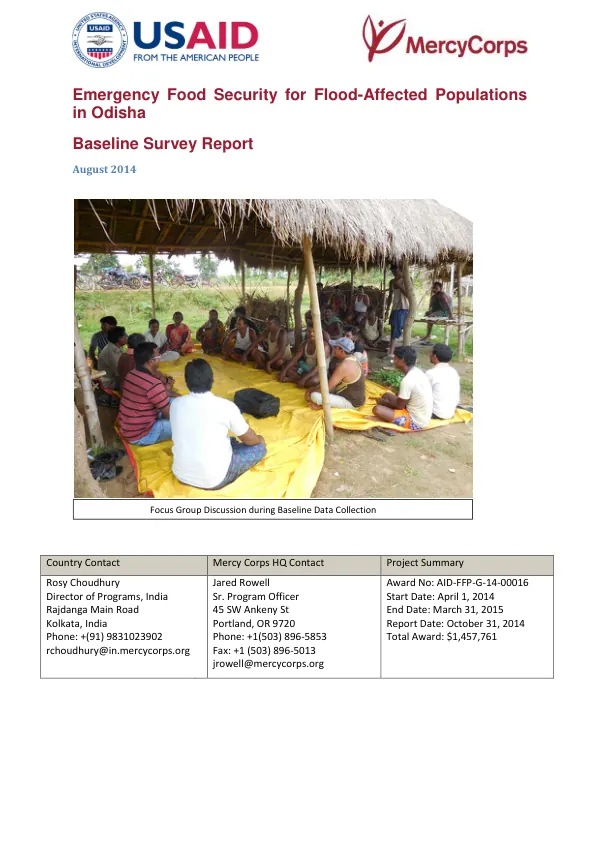
The program is an 11-month initiative starting April 1, 2014, and ending on February 28, 2015, implemented by Mercy Corps with local NGO partner, Adhikar. The program aims to support food insecure and labor-poor households affected by the floods, with a principal objective of improving food security of 17,500 people in flood-affected villages of Mayurbhanj and Balasore districts of Odisha. The program envisions that 3,500 vulnerable households will increase their food purchasing capacity in Badasahi, GB Nagar, and Nilagiri administrative blocks of Mayurbhanj and Balasore districts of Odisha. A total of 3,200 households participating in Cash for Work (CfW) activities will receive payments, and 300 of the most vulnerable households will receive unconditional cash grants for food. The baseline assessment for the project was conducted in August 2014 to provide a basis for comparison on the progress made toward program objectives and to assess the status of beneficiaries related to food consumption, income-expenditures, and availability of livelihood options. The Indian state of Odisha has the highest percentage of people living below the poverty line (57.2 percent) of any state in the country, with 80 percent of the population residing in rural areas and dependent upon farm income. Mercy Corps has worked in Odisha since 2008, helping poor farmers improve their income through access to better inputs, knowledge of better farming practices, and increasing access to markets. The initial assessment revealed that approximately 70 percent of the affected households are either landless agricultural laborers or marginal farmers with less than two acres of land whose livestock, land, and homes were destroyed or significantly damaged. The objectives of the baseline study are to understand the situation in the intervention area as it relates to food insecurity at the onset of the emergency, to understand the livelihood needs and practices of the communities so as to design interventions to address the most felt needs, and to gather baseline information to measure results of various interventions through a set of indicators. The research methodology chosen for this study consisted of four components: the sampling scheme, collection of secondary data, collection of primary data, and analysis and interpretation of data. The sampling scheme involved the selection of two blocks from Mayurbhanj district and one block from Balasore district, with a total of 813 households selected on the basis of specific criteria, including households whose houses were damaged, loss of standing crops, and loss of household utilities and assets during the last floods. The data collection process was undertaken between August 1 and 27, 2014, using a baseline questionnaire developed in line with the key components of the project, including land use pattern, extent of damage on household and community assets as well as infrastructure, the food insecurity scenario, and coping mechanism used during the floods. The data was analyzed using the statistical software SPSSv 16.0, and the results were presented in tabular and graphic form and interpreted with logic and reason.
Related documents