USAID DEC
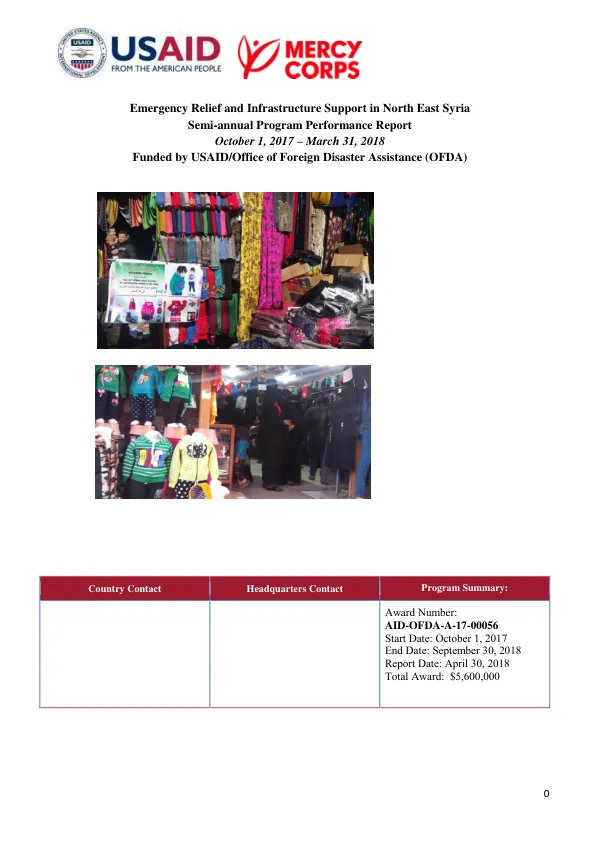
Emergency Relief and Infrastructure Support in North East Syria: Semi-annual Program Performance Report
Sign inMERCY CORPS INTERNATIONAL
Emergency Relief and Infrastructure Support in North East Syria: Semi-annual Program Performance Report
The Emergency Relief and Infrastructure Support in North East Syria program, funded by USAID/Office of Foreign Disaster Assistance (OFDA), began on October 1, 2017, and aims to provide emergency relief to an estimated 68,418 unique conflict-affected individuals.
2018 · 29 pages
Sign in to readA free account is required to download.
Abstract
The program's primary objective is to meet conflict-affected populations' basic needs and increase access to critical WASH and shelter infrastructure in Al Hasakeh, Raqqa, and Aleppo Governorates. The program's activities are led by four objectives: supporting conflict-affected households to meet their urgent basic needs, increasing purchasing power of affected populations to address shelter rehabilitation needs, improving access to water and sanitation infrastructure, and increasing operational coordination and engagement with Whole of Syria infrastructure. Mercy Corps, through its Emergency Relief and Infrastructure Support in North East Syria program, distributed vital winterization NFI support, conducted detailed technical WASH assessments, identified the most vulnerable beneficiaries for shelter support, and improved operational coordination and engagement during this reporting period. In Al-Hasakeh Governorate, a large IDP movement north towards Areesha Camp and Abu Khashab village occurred in October 2017, following the rapid advance of the Syrian Democratic Forces (SDF) and coalition forces (CF) south towards Deir ez Zor area. Local Authorities established Abu Kashab camp, and Mercy Corps' safety team conducted Security Risk Assessments for both locations. Subsequent to this movement, permissions were granted for programming teams to visit in order to conduct needs assessments. In Aleppo Governorate, a large number of incidents were reported during the report period, including IEDs targeting members of SDF/CF/the local authority, and a community strike and traders closed shops in protest against the conscription law. Tensions between the SDF and members of the Bu Banna tribe flared up over the death of two Bu Banna men, and the tribe organized a demonstration to support the Government of Syria in Menbij City. Increased IDP movement towards Menbij and other NES areas was witnessed following the Turkish military operation against Afrin. In Ar-Raqqa Governorate, Raqqa City was taken over by SDF in October 2017, and returns gradually started in November. Mercy Corps' programming teams have started responding to areas north of Ar-Raqqa in an area around the village of Kalta as well as continuing to work in Ain Issa camp and areas around Tabqa. Security risk assessments were carried out in an area east of Tabqa City and north of Ar-Raqqa, resulting in a positive indication that programming could be expanded into these areas. The program's implementation has been affected by various security concerns, including the restriction of Mercy Corps' movements and difficulties in humanitarian efforts due to the Turkish military operation against Afrin. Alternative routes have been used to reduce exposure, and field work has been temporarily suspended several times due to demonstrations condemning the attack on Afrin. Despite these challenges, Mercy Corps has continued to provide emergency relief and infrastructure support to conflict-affected populations in North East Syria.
Related documents
Documents in this collection
 2017
2017USAID DEC
Quarterly Report: October 01, 2016 – December 31, 2016, Phase 2: Emergency Response for IDPs and Conflict-Affected Communities in Yemen
Open record 2021
2021USAID DEC