INTERNATIONAL MEDICAL CORPS
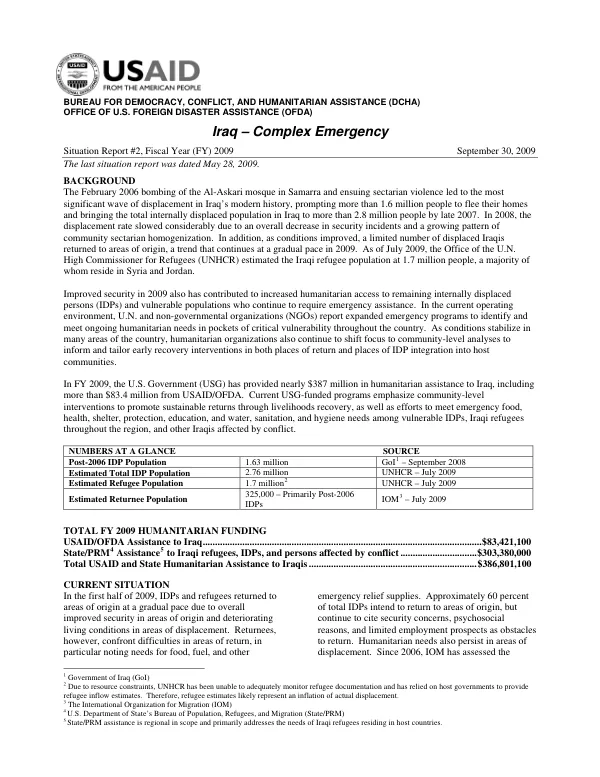
USAID-DCHA Iraq Complex Emergency Situation Report #2
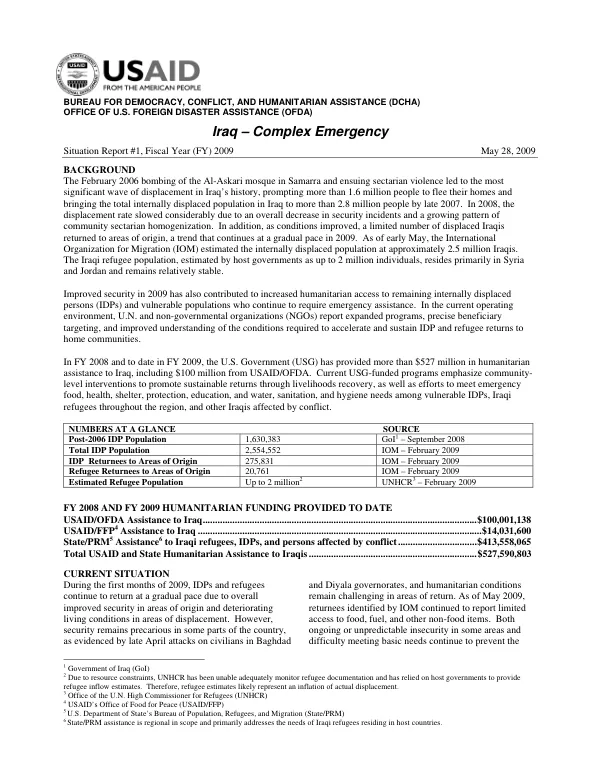
The complex emergency in Iraq has resulted in significant displacement, with more than 2.8 million people internally displaced by late 2007.
2009 · 5 pages
Sign in to readA free account is required to download.
Abstract
The displacement rate slowed in 2008 due to improved security and community sectarian homogenization, with a limited number of displaced Iraqis returning to areas of origin. As of July 2009, the Office of the U.N. High Commissioner for Refugees (UNHCR) estimated the Iraqi refugee population at 1.7 million people, with a majority residing in Syria and Jordan. Improved security in 2009 has contributed to increased humanitarian access to remaining internally displaced persons (IDPs) and vulnerable populations. U.N. and non-governmental organizations (NGOs) report expanded emergency programs to identify and meet ongoing humanitarian needs in pockets of critical vulnerability throughout the country. Humanitarian organizations are shifting focus to community-level analyses to inform and tailor early recovery interventions in both places of return and places of IDP integration into host communities. The U.S. Government (USG) has provided nearly $387 million in humanitarian assistance to Iraq in FY 2009, including more than $83.4 million from USAID/OFDA. Current USG-funded programs emphasize community-level interventions to promote sustainable returns through livelihoods recovery, as well as efforts to meet emergency food, health, shelter, protection, education, and water, sanitation, and hygiene needs among vulnerable IDPs, Iraqi refugees throughout the region, and other Iraqis affected by conflict. In the first half of 2009, IDPs and refugees returned to areas of origin at a gradual pace due to overall improved security in areas of origin and deteriorating living conditions in areas of displacement. Returnees, however, confront difficulties in areas of return, particularly noting needs for food, fuel, and other emergency relief supplies. Approximately 60 percent of total IDPs intend to return to areas of origin, but continue to cite security concerns, psychosocial reasons, and limited employment prospects as obstacles to return. Humanitarian needs also persist in areas of displacement. As of April 2009, more than 60 percent of the returnee population reported insufficient access to food, nearly 40 percent cited a lack of safe drinking water, and more than 50 percent noted inadequate quantities of fuel and other essential supplies upon returning home. In addition, many returnees are returning to find property destroyed or occupied. In June, IOM reported improved coordination between an array of actors in Baghdad to support sustainable returns to central Baghdad and surrounding districts. In FY 2009, USAID/OFDA provided approximately $60 million to programs that facilitate sustainable returns through direct assistance to returning families, support to communities with significant numbers of current or anticipated returnees, and general assistance to vulnerable populations and families regardless of displacement status. USAID/OFDA partners provide emergency relief supplies; improve water, sanitation, and hygiene facilities; offer protection services; and support economic recovery in areas of return.
Related documents