USAID DEC
Emergency Transboundary Outbreak Pest (ETOP) Situation Report for October with a Forecast till mid-December, 2012
Sign inBANK FOR WEST AFRICAN DEVELOPMENT
Emergency Transboundary Outbreak Pest (ETOP) Situation Report for October with a Forecast till mid-December, 2012
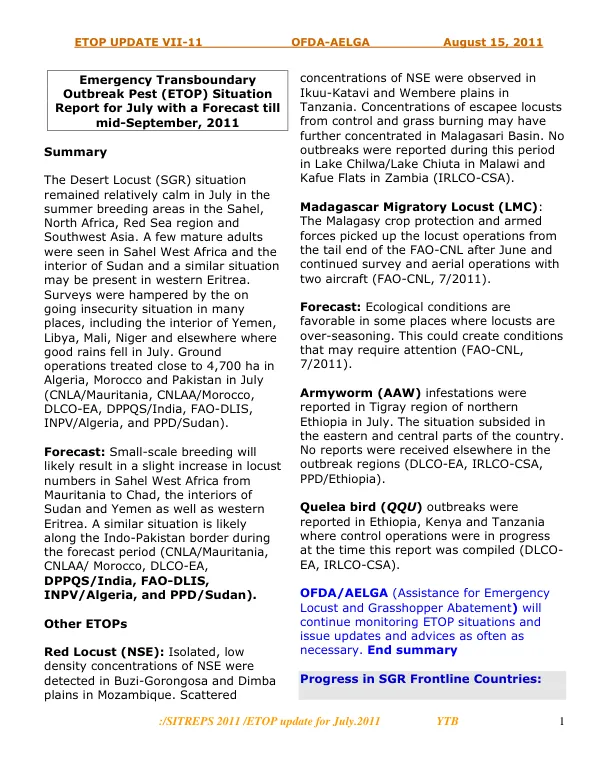
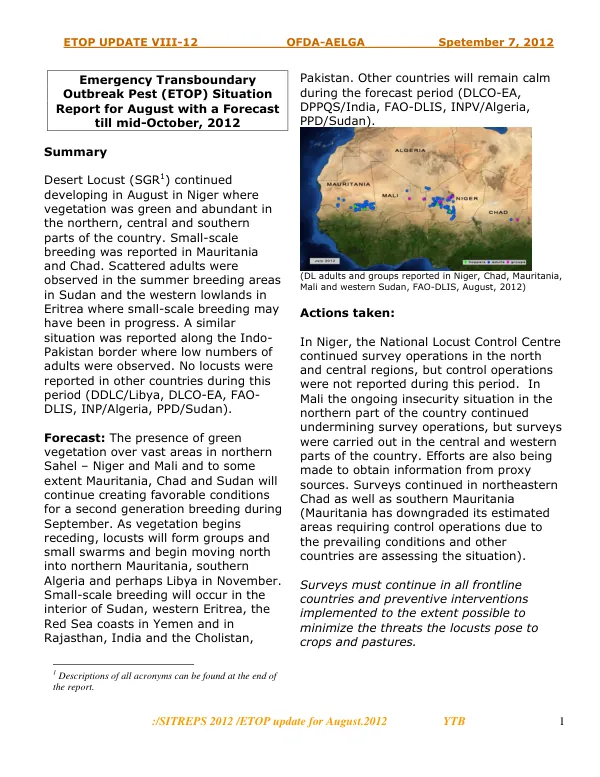
The Desert Locust (SGR1) continued to develop and form hopper bands and swarms in northeast and northwest Chad in October.
2012 · 9 pages
Sign in to readA free account is required to download.
Abstract
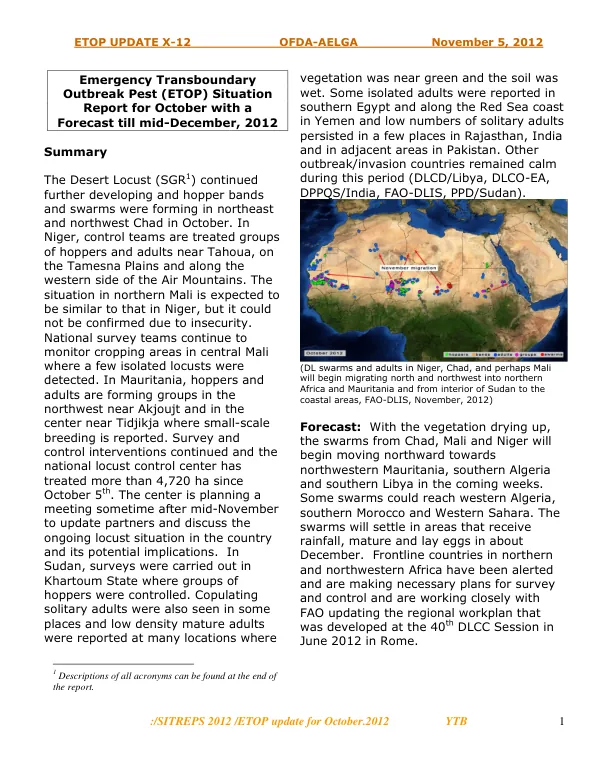
In Niger, control teams treated groups of hoppers and adults near Tahoua, on the Tamesna Plains and along the western side of the Air Mountains. The situation in northern Mali is expected to be similar to that in Niger, but it could not be confirmed due to insecurity. National survey teams continued to monitor cropping areas in central Mali where a few isolated locusts were detected. In Mauritania, hoppers and adults were forming groups in the northwest near Akjoujt and in the center near Tidjikja where small-scale breeding was reported. Survey and control interventions continued, and the national locust control center treated more than 4,720 ha since October 5th. The center is planning a meeting sometime after mid-November to update partners and discuss the ongoing locust situation in the country and its potential implications. In Sudan, surveys were carried out in Khartoum State where groups of hoppers were controlled. Copulating solitary adults were also seen in some places, and low-density mature adults were reported at many locations where vegetation was near green and the soil was wet. Some isolated adults were reported in southern Egypt and along the Red Sea coast in Yemen, and low numbers of solitary adults persisted in a few places in Rajasthan, India, and in adjacent areas in Pakistan. Other outbreak/invasion countries remained calm during this period. However, it is forecasted that DL swarms and adults in Niger, Chad, and perhaps Mali will begin migrating north and northwest into northern Africa and Mauritania and from the interior of Sudan to the coastal areas. With the vegetation drying up, the swarms from Chad, Mali, and Niger will begin moving northward towards northwestern Mauritania, southern Algeria, and southern Libya in the coming weeks. Some swarms could reach western Algeria, southern Morocco, and Western Sahara. The swarms will settle in areas that receive rainfall, mature, and lay eggs in about December. Frontline countries in northern and northwestern Africa have been alerted and are making necessary plans for survey and control and are working closely with FAO to update the regional workplan that was developed at the 40th DLCC Session in June 2012 in Rome. The Red (Nomadic) Locust (NSE) situation remained relatively calm during October, with only a good number of adult locusts persisting in Ikuu-Katavi and Wembere plains and Malagarasi Basin in Tanzania, Buzi-Gorongosa and Dimba plains in Mozambique, and Kafue Flats in Zambia. Low-density swarms persisted in Lake Chilwa/Lake Chiuta of Malawi, and breeding may have commenced in Malagarasi Basin, Buzi-Gorongosa, and Lake Chilwa/Lake Chiuta plains of Malawi where significant rains were received.
Related documents