USAID DEC
Save the Children — Bangladesh Newly Nationalized Public Schools READ Program—Midline Report
Sign inUSAID DEC
Save the Children — Bangladesh Newly Nationalized Public Schools READ Program—Midline Report
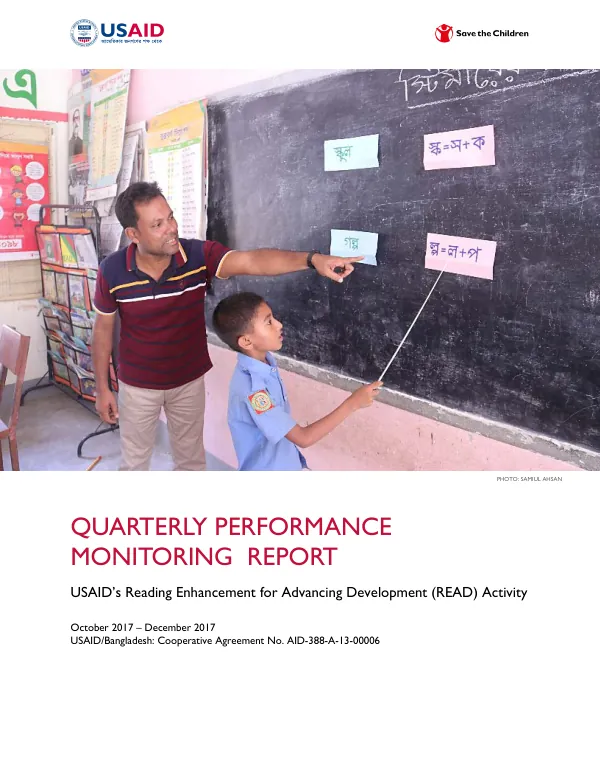
The READ program is a four-year collaboration between the Government of Bangladesh and the US Agency for International Development (USAID) to improve early grade reading.
2016 · 32 pages
Sign in to readA free account is required to download.
Abstract
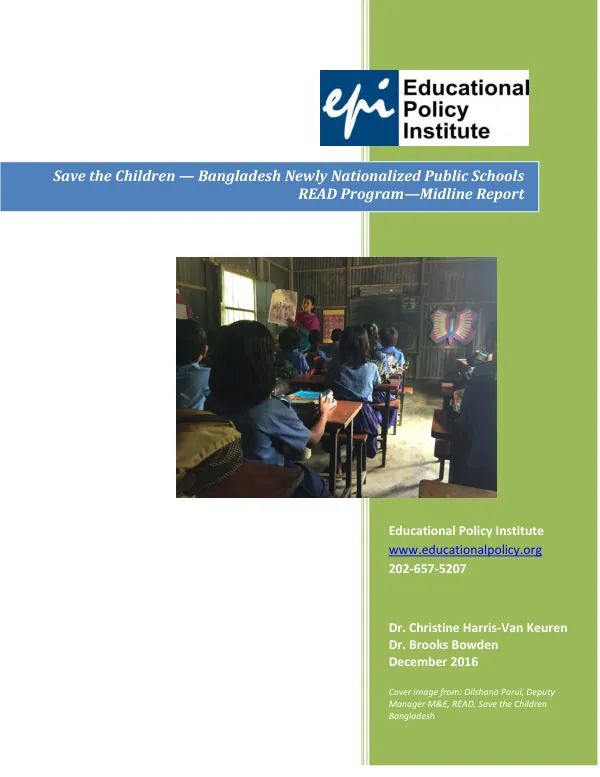
The program aims to ensure a strong foundation in reading skills for children in the primary cycle, with the expectation that fewer children will repeat grades or drop out and a higher proportion will complete school with solid primary school skills. The READ intervention targets both newly nationalized primary schools (NNP or NNPS) and mainstream government primary schools (GP or GPS). Historically, NNP schools have been underfunded and staffed by less qualified teachers, resulting in underperformance. The READ program was designed to address the literacy needs of these underperforming schools and aims to increase reading skills among grade 1-3 students in READ-supported schools in selected districts. The READ intervention has two branches: READ CORE and READ CORE PLUS. READ CORE activities include teacher training sessions, academic supervision, formative assessments, reading corners, print-rich environments, reading festivals, and data sharing. READ CORE PLUS provides the same services and materials as READ and builds upon the school-based foundation by adding a community reading camp, which is staffed by community literacy volunteers (CLVs) who utilize books and materials to reinforce learning outcomes. The community reading camp is a vibrant environment with colorful drawings and posters on the walls to engage children. The session is conducted by two CLVs who serve groups of students for one afternoon per week. The READ program is complex in terms of its design and the number of components required to potentially impact literacy rates. The objective of READ is to increase reading skills among grade 1-3 students in READ-supported schools in the selected districts. The READ program is being implemented in selected districts, and the evaluation is being conducted to assess the impact of the program on reading skills among grade 1-3 students. The evaluation will provide insights into the effectiveness of the READ program and inform future interventions to improve early grade reading in Bangladesh. The READ program has the potential to make a significant impact on the literacy rates of children in Bangladesh and contribute to the country's education sector development. The READ program's design and implementation are critical to its success. The program's complexity and the number of components involved require careful planning and execution to ensure that the program reaches its intended goals. The evaluation of the READ program will provide valuable insights into the program's effectiveness and inform future interventions to improve early grade reading in Bangladesh.
Related documents