ARIZONA STATE UNIVERSITY
Energizer | December 2016
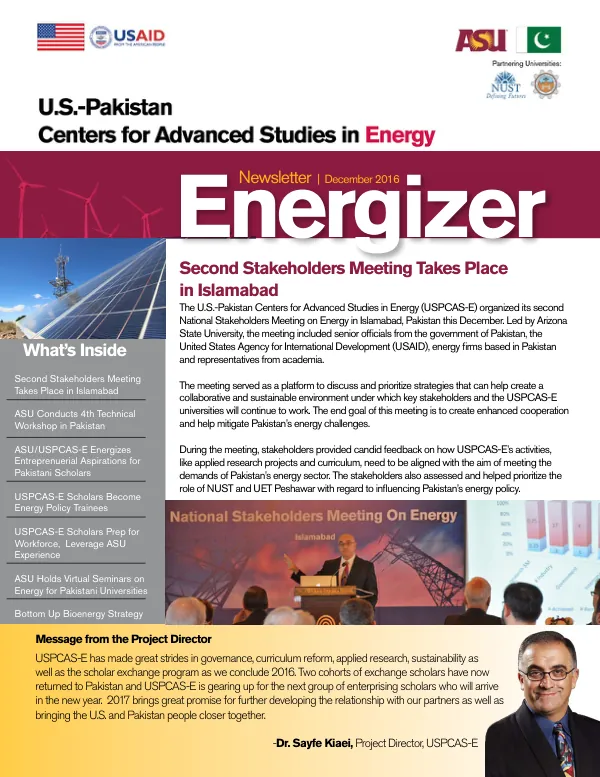
The U.S.-Pakistan Centers for Advanced Studies in Energy (USPCAS-E) held its second National Stakeholders Meeting on Energy in Islamabad, Pakistan in December.
2016 · 4 pages
Sign in to readA free account is required to download.
Abstract
The meeting brought together senior officials from the government of Pakistan, the United States Agency for International Development (USAID), energy-based companies in Pakistan, and academia. The meeting aimed to create a collaborative and sustainable environment for stakeholders and USPCAS-E universities to work together. The meeting served as a platform for stakeholders to provide candid feedback on USPCAS-E's activities, such as applied research projects and curriculum, to align with the demands of Pakistan's energy sector. The stakeholders assessed and prioritized the role of NUST and UET Peshawar in influencing Pakistan's energy policy. USPCAS-E has made significant progress in governance, curriculum reform, sustainability, and scholar exchange programs. The project director, Dr. Sayfe Kiaei, expressed his enthusiasm for the initiative's potential to develop further partnerships with USPCAS-E and bring the U.S. and Pakistan people closer together. Arizona State University (ASU) conducted its fourth technical workshop in Pakistan in December. The workshop focused on green buildings and energy efficiency in Pakistan. The workshop was led by Professor Harvey Bryan, who noted that students from NUST and UET were engaged and interested in moving green buildings into mainstream Pakistani practices. The workshop aimed to create a strong sustainable foundation for Pakistan's energy sector. The participants learned about green building projects and their impact on the environment. Dr. Bryan stated that the workshop was a success, with participants showing enthusiasm for green building practices. The second cohort of Pakistani engineering scholars completed their entrepreneurship course of study at ASU. The scholars studied engineering, policy, and entrepreneurship to enact change and improve their country's energy prospects. The scholars' final projects showed potential for innovative and entrepreneurial solutions to Pakistan's energy challenges. The scholars, including Nafeesa Irshad and Bilal Malik, were hosted by ASU's School for the Future of Innovation in Energy Policy and Leadership. They attended weekly seminars with different presenters, such as faculty members and affiliates. The scholars praised the culturally diverse student environment and the support they received from faculty and peers. In October, 27 scholars were trained at ASU in job-seeking skills like resume writing and interview preparation. The training aimed to equip the scholars with the skills necessary to succeed in the workforce. The scholars were also trained in entrepreneurship and commercialization, with a focus on solving complex technical problems in energy generation and distribution. The scholars' projects showed potential for innovative and entrepreneurial solutions to Pakistan's energy challenges. The scholars, including Nafeesa Irshad and Bilal Malik, hope to take their plans back home and turn them into entrepreneurial ventures in Pakistan's energy sector.