USAID DEC
Energy Opportunities for Agricultural Systems and Food Security Project: Solar PV Options for Small-Scale Dairy Aggregators
Sign inACDI/VOCA
Energy Opportunities for Agricultural Systems and Food Security Project: Solar PV Options for Small-Scale Dairy Aggregators
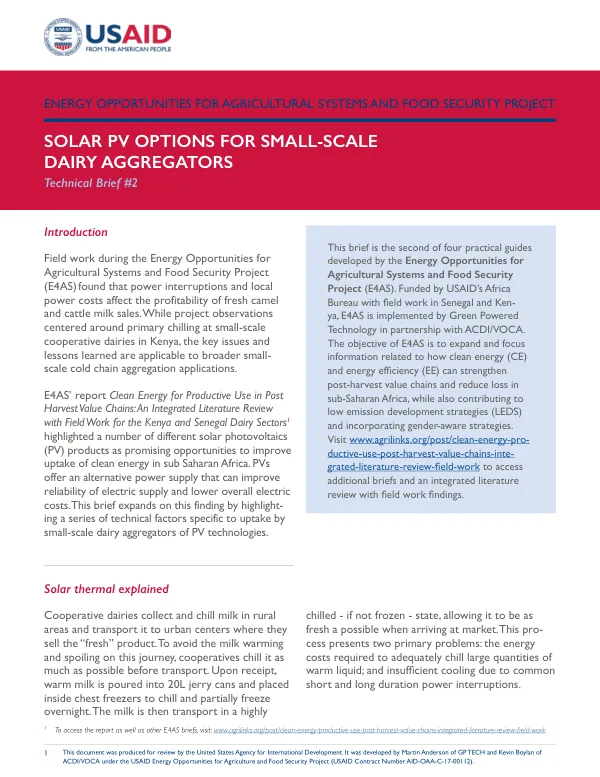
The Energy Opportunities for Agricultural Systems and Food Security Project (E4AS) identified power interruptions and local power costs as significant challenges affecting the profitability of fresh camel and cattle milk sales in Kenya.
2018 · 3 pages
Sign in to readA free account is required to download.
Abstract
The project's report, Clean Energy for Productive Use in Post Harvest Value Chains: An Integrated Literature Review with Field Work for the Kenya and Senegal Dairy Sectors, highlighted solar photovoltaics (PV) as a promising opportunity to improve the uptake of clean energy in sub-Saharan Africa. PV systems offer an alternative power supply that can improve the reliability of electric supply and lower overall electric costs. Cooperative dairies in Kenya collect and chill milk in rural areas and transport it to urban centers where they sell the "fresh" product. To avoid milk warming and spoiling during transport, cooperatives chill it as much as possible before transport. However, this process presents two primary problems: the energy costs required to adequately chill large quantities of warm liquid, and insufficient cooling due to common short and long duration power interruptions. The installation of photovoltaic (PV) systems to generate power and battery storage can allow cooperatives to improve the surety and consistency of energy supply and lower overall energy costs. A solar-powered system with battery storage can provide either a complete off-grid power supply or a system to provide back-up power during utility interruptions. A 100% solar power supply would include sufficient photovoltaic panels to generate power throughout the daylight hours to provide the immediate power requirements and to charge batteries to provide power throughout the nighttime hours. The avoided annual power costs can be calculated based on past utility bills, estimated at US$4,600 annually. The reduction of costs due to milk spoilage must also be considered, which is difficult to estimate without exact records. Interviews with cooperative members showed it reasonable to assume that utility power interruptions and outages result in at least one loss of fresh milk per month, costing the cooperative approximately US$4,200/year. The total annual savings with a 100% solar-powered system with 16 hours of battery storage would be approximately US$8,800/year for an investment of approximately US$47,000. This would result in a simple payback of just over five years. Reducing the total amount of hours of required storage, while continuing to supplement with power purchased from a utility, will reduce the overall installation cost. For example, a reduction in the storage capacity from 16 hours to 8 hours would reduce installation costs by US$15,000 to US$32,000. Such an approach would still require the purchase of power from a utility, resulting in a total energy bill savings of US$3,070 per year. The same reduction of milk spoilage costs is also applicable under this scenario, resulting in a total annual savings of US$7,270 per year.