CATHOLIC RELIEF SERVICES ORGANIZATION
ENGINE Participates in Global Nutrition Conference
The 2015 Integrated Nutrition Conference was organized by the Catholic Relief Services (CRS) at the Royal Orchid Hotel in Nairobi, Kenya on September 14 and 15, 2015.
2015 · 2 pages
Sign in to readA free account is required to download.
Abstract
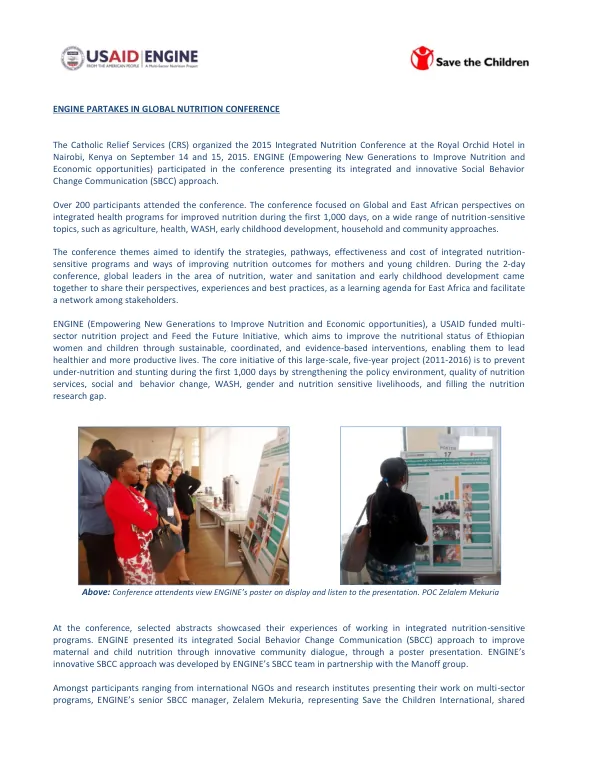
The conference brought together over 200 participants to discuss global and East African perspectives on integrated health programs for improved nutrition during the first 1,000 days. Topics covered included agriculture, health, water, sanitation, and hygiene (WASH), early childhood development, household, and community approaches to nutrition. The conference aimed to identify strategies, pathways, effectiveness, and cost of integrated nutrition-sensitive programs and ways of improving nutrition outcomes for mothers and young children. Global leaders in nutrition, water and sanitation, and early childhood development shared their perspectives, experiences, and best practices, facilitating a network among stakeholders. ENGINE, a USAID-funded multi-sector nutrition project, presented its integrated Social Behavior Change Communication (SBCC) approach to improve maternal and child nutrition through innovative community dialogue. ENGINE's SBCC approach was developed in partnership with the Manoff group and showcased at the conference through a poster presentation. The approach focused on community conversation and engagement to bring about social behavior change in Ethiopia. Preliminary findings from the project implementation sites highlighted the effectiveness of the innovative community conversation approach in improving maternal and child nutrition. The conference provided a platform for international NGOs and research institutes to present their work on multi-sector programs. ENGINE's senior SBCC manager, Zelalem Mekuria, representing Save the Children International, shared insights on interactive approaches and methods used to engage communities and bring about social behavior change. The conference outcomes and findings from the poster presentation are available for further information. ENGINE is a large-scale, five-year project (2011-2016) funded by USAID and the Feed the Future Initiative. The project aims to improve the nutritional status of Ethiopian women and children through sustainable, coordinated, and evidence-based interventions. The core initiative of the project is to prevent under-nutrition and stunting during the first 1,000 days by strengthening the policy environment, quality of nutrition services, social and behavior change, WASH, gender, and nutrition-sensitive livelihoods, and filling the nutrition research gap.