CATHOLIC RELIEF SERVICES ORGANIZATION
FY19 – Q2 Performance Report: Gikuriro - Integrated Nutrition and WASH Activity
The Gikuriro Program is a five-year Integrated Nutrition and WASH activity funded by USAID.
2019 · 56 pages
Sign in to readA free account is required to download.
Abstract
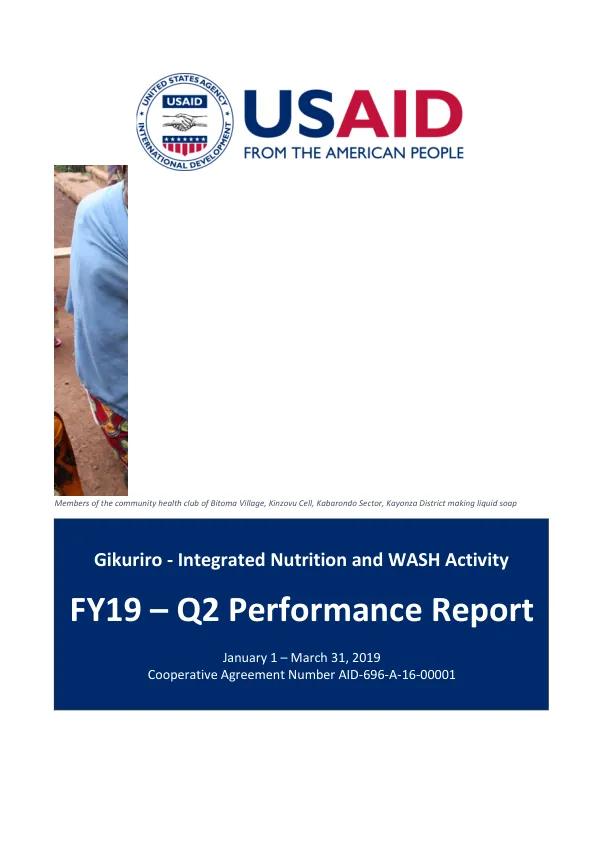
The program is implemented through a consortium of two international agencies, Catholic Relief Services (CRS) as the prime and a sub-recipient, SNV, the Netherlands Development Organization. The primary purpose of Gikuriro is to improve the nutritional status of women of reproductive age and children under five years of age, with an emphasis on the 1,000-day window of opportunity from pregnancy until a child's second birthday, in support of the Government of Rwanda's (GOR) efforts. Gikuriro key achievements in the reporting period include nutrition support to 1,110 villages, where participants learned and practiced preparation of balanced diets and infants and young children feeding, and growth monitoring was conducted. In the reporting period, 36,291 children, 3,879 lactating mothers, 1,014 pregnant women, and 2,653 men attended VNS learning sessions. Among the children followed, 446 were rehabilitated. Capacity strengthening of service providers and districts to achieve improved nutritional outcomes was also a major accomplishment. Gikuriro conducted a community of practice and learning meeting where partners shared good innovations and learned from each other on best practices. Internal dissemination of LCSOs' overall capacity assessment findings and individual debriefing of Gikuriro partners on LCSO's capacity assessment findings and capacity building plans based on identified gaps were also conducted. In the agriculture sector, Gikuriro supported 20 schools from four districts that received water tanks to create junior FFLS and establish school gardens. Through the offspring sharing system, 1,751 beneficiaries received small livestock, and 1,991 Mamans Lumières were provided with hens to produce eggs for children during cooking demonstrations. Gikuriro also supported 6,060 households to establish kitchen gardens during the agriculture season 2019B launch and campaign. Economic strengthening through the Savings and Internal Lending Community (SILC) and Private Service Provider (PSP) approach was another key achievement. Gikuriro supported 241 SILC groups from cohort two to share out savings and interest earned during the cycle. The groups shared out 109,389,040 RwF and earned 27% interest on their savings. In addition, Gikuriro certified 99 field agents from cohort two sectors to become Private Service Providers to work independently on fees for services. In the Water Sanitation and Hygiene (WASH) sector, Gikuriro supported 90 CHC members from Rwamagana, Kayonza, and Ngoma districts to receive hands-on skill training on local soap production and a training of trainers on SILC and saving group creation within CHC. The objective of the trainings was to sustain handwashing at critical moments by increasing soap affordability and ensuring CHC functionality and to increase household access to sanitation and hygiene products and services. Gikuriro also provided training to District WASH Boards (DWASHBs), SAHO, private operators, and LCSOs' WASH officers. The program organized a training for sixteen LCSO WASH Officers on water resource supply systems and management based on the gaps identified from the capacity assessment. The objective was to fill the identified knowledge gaps in spring protection, preparation, and evaluation of bid documents for water supply infrastructure, water safety plans, water and sanitation service indicators, and reporting. In addition, Gikuriro distributed 992 LifeStraw water filters to households in thirty villages of Rwamagana district. Households from target communities constructed 6,771 basic toilets and 11,909 handwashing stations. Furthermore, 53,785 (24%) households have regularly used handwashing facilities/tippy taps with water and soap since the start of the program. The tendering process for the rehabilitation/construction of community water spring, kiosks, and boreholes was initiated. Behavior Change Communication (BCC) was also a key component of the Gikuriro Program. Gikuriro in collaboration with MoH, NECDP, and UNICEF disseminated the National Integrated ECD, Nutrition, and WASH SBCC Strategy. Gikuriro completed the mHealth pilot study in Ngoma and Kayonza districts. Data from both baseline and end-line surveys were analyzed to see comparative advantages of using ICT-based messaging. The results will be disseminated in FY19Q3. Gikuriro sensitized 418 cell women representatives and ECD caregivers on MIYCN practices and recommended health services in Kicukiro, Nyarugenge, Kayonza, and Kicukiro districts. The Gikuriro Mid-Term Evaluation was conducted, and the results will be used to inform program adjustments and improvements.
Related documents