USAID DEC
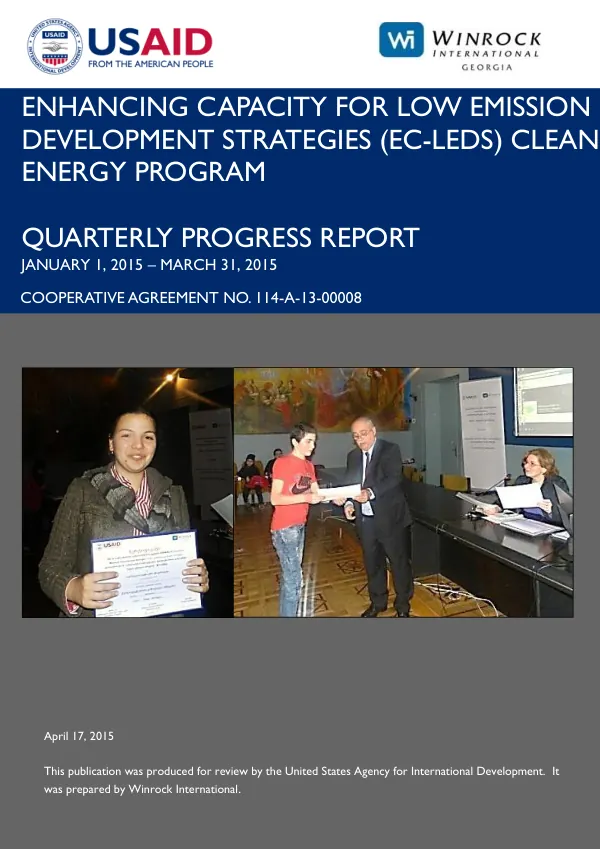
Enhancing Capacity for Low Emission Development Strategies (EC-LEDS) Clean Energy Program, Quarterly Progress Report (January 1, 2015 – March 31, 2015)
Sign inWINROCK INTERNATIONAL FOUNDATION
Enhancing Capacity for Low Emission Development Strategies (EC-LEDS) Clean Energy Program, Quarterly Progress Report (January 1, 2015 – March 31, 2015)
Enhancing Capacity for Low Emission Development Strategies (EC-LEDS) Clean Energy Program, Quarterly Progress Report (January 1, 2015 – March 31, 2015), was submitted to the United States Agency for International Development (USAID) on April 17, 2015.
2015 · 109 pages
Sign in to readA free account is required to download.
Abstract
The report highlights key achievements and progress made by the EC-LEDS Program in Georgia during the first quarter of 2015. Progress to date is reported in the program's quarterly progress report. Component 1, Georgian Municipal Energy Efficiency (GeMunee), has made significant strides in developing and implementing Sustainable Energy Action Plans (SEAPs) for municipalities. By the end of the first quarter, 15 municipalities had completed their SEAPs, with a total of 30 municipalities expected to complete the process by the end of the year. Additionally, 10 Sustainable Energy Offices or Regional Sustainable Energy Resource Centers have been established to support the implementation of SEAPs. Component 2, Green Building Rating and Certification System, has focused on developing and implementing a voluntary system for rating and certifying energy-efficient and green buildings. A draft of the system was completed in the first quarter, and a promotional strategy and campaign were developed to raise awareness about the benefits of green building practices. The system is expected to be launched in the second quarter of 2015. Component 3, National EC-LEDS Working Group and Advisory Assistance, has provided sectoral working groups (SWG) and advisory assistance to the Climate Change Office of the Ministry of Environmental Protection and Regional Development (MoENRP) and the Government of Georgia (GOG). The working group has also assisted in the development of a national climate change strategy and action plan. Environmental protection activities have been ongoing throughout the first quarter, with a focus on reducing greenhouse gas emissions and promoting sustainable development practices. Cross-cutting activities, including national public communications and outreach, people with disabilities (PWD), youth, and gender, have also been implemented to ensure that the program's benefits are accessible to all segments of the population. The EC-LEDS Program has also made significant progress in its Year 2 Work Plan, with deliverables submitted in the second quarter of 2015. The program's schedule of planned future events, including training sessions and workshops, has been outlined in Annex I. Annex II provides a list of planned deliverables and products for the third quarter of 2015, including communications and outreach materials, monitoring and evaluation reports, and environmental compliance documents. A success story from the program is highlighted in Annex III, showcasing the impact of the program's activities on the local community. Media coverage reports for January-February 2015 and March 2015 are provided in Annexes IV and V, respectively, highlighting the program's visibility and reach in the local media. Overall, the EC-LEDS Program has made significant progress in its first quarter of 2015, with a focus on developing and implementing sustainable energy practices, promoting green building practices, and providing advisory assistance to the Government of Georgia. The program's continued efforts are expected to contribute to the reduction of greenhouse gas emissions and the promotion of sustainable development practices in Georgia.
Related documents
Documents in this collection
 2016
2016USAID DEC
Enhancing Capacity for Low Emission Development Strategies (EC-LEDS) Clean Energy Program, Quarterly Progress Report (April 1, 2016 – June 30, 2016)
Open record 2016
2016USAID DEC