USAID DEC
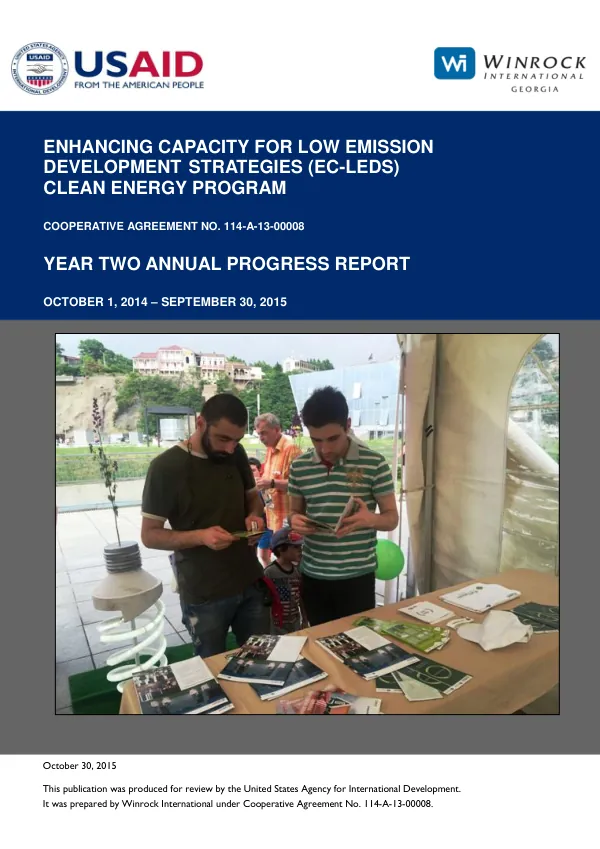
Enhancing Capacity for Low Emission Development Strategies (EC-LEDS) Clean Energy Program Year Two Annual Report (Oct 2014 – September 2015)
Sign inTHE GOVERNMENT OF GEORGIA
Enhancing Capacity for Low Emission Development Strategies (EC-LEDS) Clean Energy Program Year Two Annual Report (Oct 2014 – September 2015)
The EC-LEDS Clean Energy Program is a four-year effort that supports Georgia's efforts to increase climate change mitigation through energy efficiency and clean energy.
2015 · 140 pages
Sign in to readA free account is required to download.
Abstract
The program focuses on three activities: Georgian Municipal Energy Efficiency (GeMunee), Green Building (GB) Rating and Certification System, and National EC-LEDS Working Group and Advisory Assistance. The program is funded by USAID/Caucasus and implemented by Winrock International. The EC-LEDS Clean Energy Program aims to build municipal capacity in climate change mitigation measures, raise public awareness, increase private sector investment in energy efficiency and Green Building, and strengthen the Government of Georgia's capacity to develop and implement a national Low Emission Development Strategy (LEDS). The program's broader goal is to enable more responsible management and development of Georgia's natural endowments. During its four-year duration, the EC-LEDS Clean Energy Program is expected to reduce greenhouse gas (GHG) emissions in Georgia by at least 236,372.9 metric tons of CO2 equivalent, facilitate up to $14 million in private sector investments in clean energy, and lead to energy savings of up to 315 GWh (the equivalent of approximately $22 million). In Year Two, the program achieved several key milestones. The finalization of Sustainable Energy Action Plans (SEAPS) was a major accomplishment, with seven SEAPs completed. These plans provide a roadmap for municipalities to reduce energy consumption and greenhouse gas emissions. The program also made progress in developing the Green Building Rating System, which aims to promote energy-efficient building practices in Georgia. The National EC-LEDS Working Group and Advisory Assistance component of the program continued to provide technical assistance to the Government of Georgia, helping to develop and implement a national LEDS. The program also conducted outreach and awareness-raising activities, including the development of public service announcements and the creation of a media plan to promote energy efficiency and clean energy. In addition to these accomplishments, the program made significant progress in implementing its activities. The GeMunee component of the program worked with municipalities to develop energy efficiency plans and implement energy-saving measures. The Green Building component of the program continued to develop the Green Building Rating System and provided training and technical assistance to building owners and developers. The program's environmental protection activities also made significant progress, with the development of an Environmental Monitoring and Mitigation Plan (EMMP) and the implementation of measures to reduce greenhouse gas emissions. The program's cross-cutting activities, including project administration and year three work planning, were also completed. Overall, the EC-LEDS Clean Energy Program made significant progress in Year Two, achieving key milestones and making progress towards its goals. The program's activities are expected to continue to contribute to the reduction of greenhouse gas emissions and the promotion of energy efficiency and clean energy in Georgia. The program's success is attributed to the collaboration and coordination among the program's stakeholders, including the Government of Georgia, municipalities, private sector companies, and civil society organizations. The program's activities are expected to continue to have a positive impact on Georgia's energy sector and contribute to the country's efforts to reduce greenhouse gas emissions and promote sustainable development. The program's Year Three Work Plan outlines the activities and milestones that the program will achieve in the upcoming year. The plan includes the development of a national Green Building Rating System, the implementation of energy efficiency measures in municipalities, and the continuation of outreach and awareness-raising activities. The program's Year Three Work Plan is expected to build on the progress made in Year Two and contribute to the program's overall goals. The program's deliverables and products submitted during Year Two include the finalization of SEAPs, the development of the Green Building Rating System, and the implementation of environmental protection activities. The program's lessons learned from Year Two are also documented, providing valuable insights and recommendations for future program implementation. Overall, the EC-LEDS Clean Energy Program is making significant progress towards its goals, and its activities are expected to continue to contribute to the reduction of greenhouse gas emissions and the promotion of energy efficiency and clean energy in Georgia.
Related documents
Documents in this collection
 2015
2015USAID DEC
Enhancing Capacity for Low Emission Development Strategies (EC-LEDS) Clean Energy Program Year Two Annual Report (Oct 2014 – September 2015)
Open record 2016
2016USAID DEC