USAID DEC
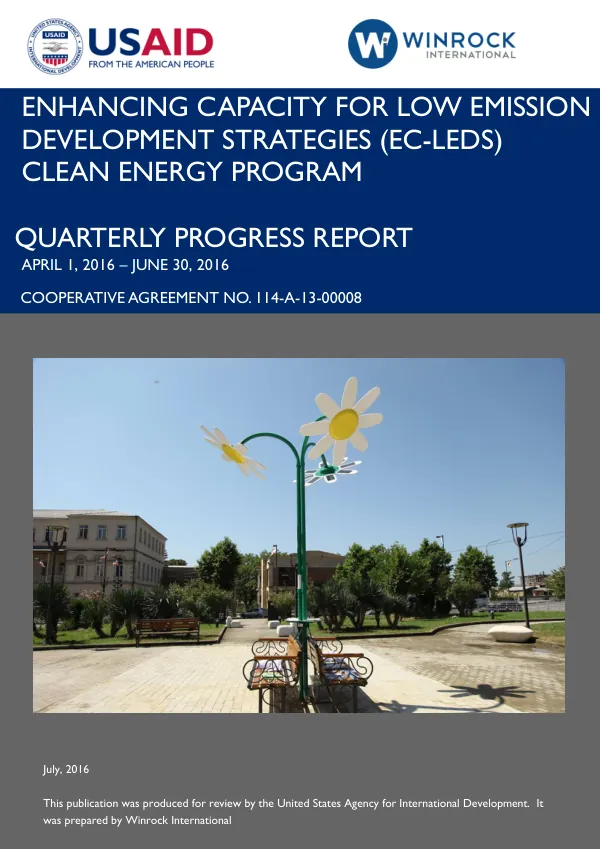
Enhancing Capacity for Low Emission Development Strategies (EC-LEDS) Clean Energy Program, Quarterly Progress Report (April 1, 2016 – June 30, 2016)
Sign inWINROCK INTERNATIONAL FOUNDATION
Enhancing Capacity for Low Emission Development Strategies (EC-LEDS) Clean Energy Program, Quarterly Progress Report (April 1, 2016 – June 30, 2016)
Enhancing Capacity for Low Emission Development Strategies (EC-LEDS) Clean Energy Program, Quarterly Progress Report (April 1, 2016 – June 30, 2016), was submitted in July 2016.
2016 · 76 pages
Sign in to readA free account is required to download.
Abstract
The report was prepared by Winrock International for review by the United States Agency for International Development. The EC-LEDS Clean Energy Program aims to enhance capacity for low emission development strategies in Georgia. The program focuses on three components: Component One, Georgian Municipal Energy Efficiency (GeMunee); Component Two, Green Building Rating and Certification System; and Component Three, National EC-LEDS Working Group and Advisory Assistance. During the third quarter of year three, significant progress was made in Component One. The Muni-EIPMP Analytical Tool was developed, and sustainable energy offices or regional sustainable energy resource centers were established. Monitoring/Reporting/Verification (MRV) plans, sustainable energy public awareness plans, and demonstration projects through partial grants were also implemented. Additionally, development credit authority guarantees and financial institution assistance were provided. Component Two, the Green Building Rating and Certification System, was completed during the third quarter. Component Three, the National EC-LEDS Working Group and Advisory Assistance, provided support to the Government of Georgia in developing the LEDS document. Analytical and advisory services, capacity building, and technical assistance were also provided. The program administration, environmental protection activities, and cross-cutting activities, including national public communications and outreach, people with disabilities, youth, and gender, were also implemented. Cooperation with other USAID programs was maintained. The year three work plan deliverables submitted in the third quarter included reports on Component One, Component Two, Component Three, public outreach, environmental compliance, and other activities. The planned future events for the fourth quarter included deliverables and products for Component One, Component Two, Component Three, communications and outreach, monitoring and evaluation, environmental compliance, and other activities. The EC-LEDS youth Energy Efficiency Event was held, with participants, content, and logistics reported. The event included a contest questionnaire, awards, and photos. Media coverage of the event was also reported. The program used various acronyms, including AD (Analytic Department), AOR (Agreement Officer’s Representative), ASHRAE (American Society of Heating, Refrigerating and Air-Conditioning Engineers), BAU (Business as Usual), BP (British Petroleum), BREEAM (Building Research Establishment Environmental Assessment Method), CBSM (Community Based Social Marketing), CC (Climate Change), CFL (Compact Fluorescent Lightbulb), CoM (Covenant of Mayors), COP (Chief of Party), DCA (Development Credit Authority), DCOP (Deputy Chief of Party), DWG (Decision Ware Group), EB (Energy Balance), EBRD (European Bank for Reconstruction and Development), EC-LEDS (Enhancing Capacity for Low Emission Development Strategies), E5P (Eastern European Energy Efficiency and Environment Partnership), EE (Energy Efficiency), EPBD (Energy Performance of Buildings Directive), and EU (European Union).
Related documents
Documents in this collection
 2016
2016USAID DEC
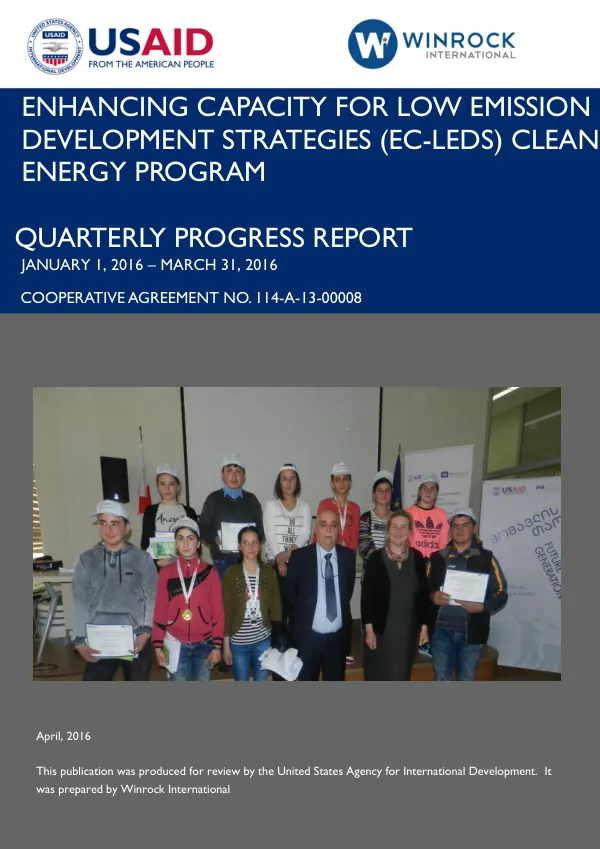
Enhancing Capacity for Low Emission Development Strategies (EC-LEDS) Clean Energy Program, Quarterly Progress Report (January 1, 2016 – March 31, 2016)
Open record 2015
2015USAID DEC