USAID DEC
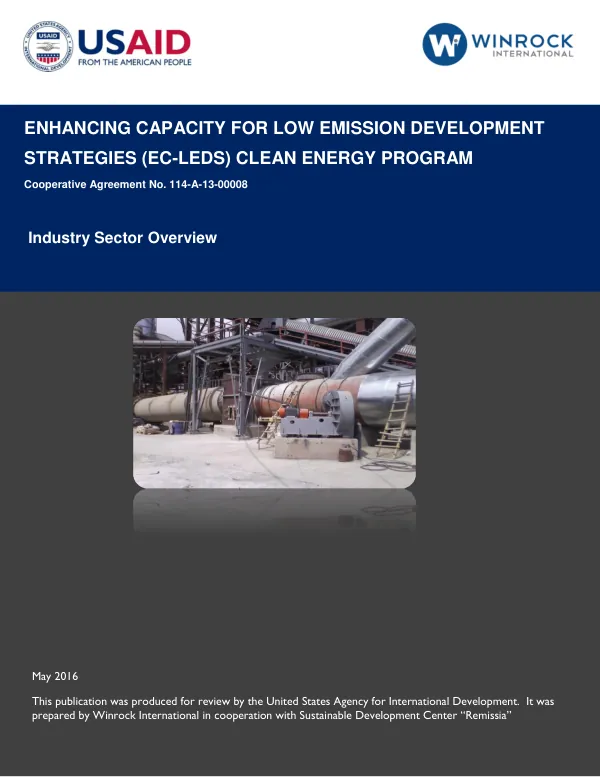
Enhancing Capacity for Low Emission Development Strategies (EC-LEDS) Clean Energy Program Industry Sector Overview
Sign inMINISTRY OF ENVIRONMENT AND SUSTAINABLE DEVELOPMENT
Enhancing Capacity for Low Emission Development Strategies (EC-LEDS) Clean Energy Program Industry Sector Overview
The industry sector plays a significant role in the development of Georgia's economy, accounting for 16.9% of the country's Gross Domestic Product (GDP).
2016 · 23 pages
Sign in to readA free account is required to download.
Abstract
The sector is composed of various sub-sectors, including chemical and petrochemical, iron and steel, food, beverages and tobacco, non-metallic minerals, transport equipment, machinery, mining and quarrying, paper, pulp and printing, wood and wood products, textiles and leather, and not elsewhere specified industry. In 2014, 6,684 industrial enterprises were registered in Georgia, with 536 large, 661 medium, and 5,487 small enterprises. The largest number of industrial enterprises is registered under the food, beverages and tobacco sub-sector. The energy balance of Georgia covers the energy consumption of these sub-sectors, with the construction sector accounted for under the industry sector. According to the data of the National Statistics Office of Georgia, the largest industrial enterprises in terms of energy consumption are HeidelbergCement Georgia, Rustavi Azot, and Georgian Manganese. The Georgian "Law on Entrepreneurs" regulates industrial entrepreneurship, mainly its administrative and legal issues. The Department of Economic Growth and Planning at the Ministry of Economic and Sustainable Development is responsible for coordinating the policy for economic growth of Georgia, including the industry sector. The Unit of Sustainable Development of the same Ministry is responsible for elaborating the strategy for sustainable development and supporting state programs. The industry sector's energy consumption is significant, with the largest sub-sectors being chemical and petrochemical, iron and steel, and food, beverages and tobacco. The energy balance of Georgia shows that the construction sector has the highest production, while the food, beverages and tobacco sub-sector accounts for the biggest share of value added within the industry sector. The largest industrial enterprises in terms of energy consumption are HeidelbergCement Georgia, Rustavi Azot, and Georgian Manganese. The analysis of energy-intensive enterprises in Georgia reveals that HeidelbergCement Georgia, Rustavi Azot, and Georgian Manganese are the largest industrial enterprises in terms of energy consumption. The energy consumption intensity in energy-intensive sub-sectors of industry in 2014 was significant, with the chemical and petrochemical sub-sector having the highest energy consumption intensity. The industry sector's greenhouse gas (GHG) emissions from fossil fuel combustion are also significant, with the largest sub-sectors being chemical and petrochemical, iron and steel, and food, beverages and tobacco. The energy balance of Georgia shows that the construction sector has the highest production, while the food, beverages and tobacco sub-sector accounts for the biggest share of value added within the industry sector. The main barriers and challenges for low-emission development in the industry sector of Georgia include the lack of energy-efficient technologies, inadequate institutional framework, and limited access to finance. The analysis of energy-intensive enterprises in Georgia reveals that the largest industrial enterprises in terms of energy consumption are HeidelbergCement Georgia, Rustavi Azot, and Georgian Manganese.
Related documents
Documents in this collection
 2016
2016USAID DEC
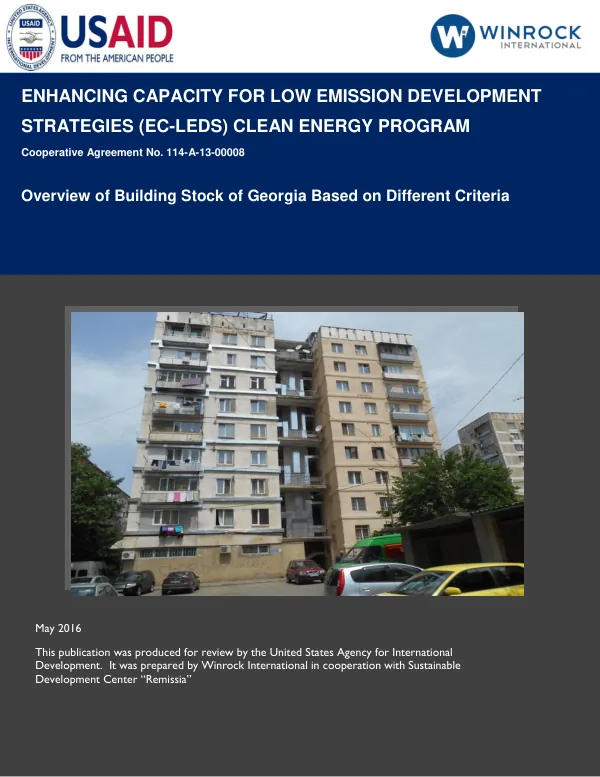
Enhancing Capacity for Low Emission Development Strategies (EC-LEDS) Clean Energy Program: Overview of Building Stock of Georgia Based on Different Criteria
Open record 2016
2016USAID DEC