USAID DEC
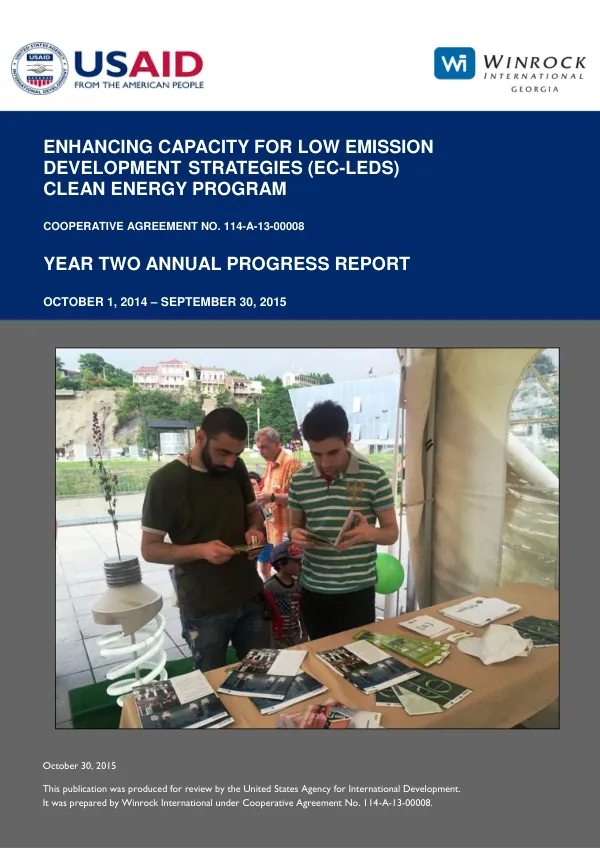
Enhancing Capacity for Low Emission Development Strategies (EC-LEDS) Clean Energy Program Year Two Annual Report (Oct 2014 – September 2015)
Sign inTHE GOVERNMENT OF GEORGIA
Enhancing Capacity for Low Emission Development Strategies (EC-LEDS) Clean Energy Program Year Two Annual Report (Oct 2014 – September 2015)
The EC-LEDS Clean Energy Program is a four-year effort that supports Georgia's efforts to increase climate change mitigation through energy efficiency and clean energy.
2015 · 146 pages
Sign in to readA free account is required to download.
Abstract
The program focuses on three activities: Georgian Municipal Energy Efficiency (GeMunee), Green Building (GB) Rating and Certification System, and National EC-LEDS Working Group and Advisory Assistance. The program is funded by USAID/Caucasus and implemented by Winrock International. The EC-LEDS Clean Energy Program aims to build municipal capacity in climate change mitigation measures, raise public awareness, increase private sector investment in energy efficiency and Green Building, and strengthen the Government of Georgia's capacity to develop and implement a national Low Emission Development Strategy (LEDS). The program's broader goal is to enable more responsible management and development of Georgia's natural endowments. During its four years, the EC-LEDS Clean Energy Program is expected to reduce greenhouse gas (GHG) emissions in Georgia by at least 236,372.9 metric tons of CO2-equivalent, facilitate up to $14 million in private sector investments in clean energy, and lead to energy savings of up to 315 GWh (the equivalent of approximately $22 million). In Year Two, the program achieved several key highlights. The finalization of Sustainable Energy Action Plans (SEAPS) was a major accomplishment, with seven SEAPs completed for the COM-signatory cities of Tbilisi, Batumi, Kutaisi, Zugdidi, Gori, Telavi, and Akhaltsikhe. This covers 37% of the country's total population. Additionally, Monitoring, Review, and Verification (MRV) plans were developed for each SEAP. The program also made progress in Municipal Inventory, Projection, and Mitigation Planning (MUNI-EIPMP), with the development of a comprehensive inventory of municipal energy consumption and greenhouse gas emissions. This inventory will serve as a basis for future planning and decision-making. Furthermore, the program continued to support the development of a Green Building (GB) Rating and Certification System, with the establishment of a Green Building Certification Working Group (GBCWG) and the development of a rating system for green buildings. The program also conducted outreach and awareness-raising activities to promote energy efficiency and green building practices among the public and private sectors. In addition, the program provided technical assistance to the Government of Georgia to support the development of a national Low Emission Development Strategy (LEDS). This included the conduct of a scoping study and the development of a draft LEDS document. Overall, the EC-LEDS Clean Energy Program made significant progress in Year Two, achieving key milestones in the development of sustainable energy action plans, municipal inventory and mitigation planning, green building rating and certification, and national LEDS development. The program's continued support and technical assistance will be crucial in helping Georgia achieve its climate change mitigation goals. The program's activities were implemented through three main components: Georgian Municipal Energy Efficiency (GeMunee), Green Building (GB) Rating and Certification System, and National EC-LEDS Working Group and Advisory Assistance. The program's progress was monitored and evaluated through a Performance Monitoring Plan (PMP), which tracked key indicators and milestones. The EC-LEDS Clean Energy Program's success in Year Two was due in part to the strong partnership between the program's implementing partner, Winrock International, and the Government of Georgia. The program's technical assistance and capacity-building activities helped to build the capacity of the Government of Georgia to develop and implement sustainable energy policies and practices. The program's achievements in Year Two demonstrate the importance of international cooperation and technical assistance in supporting developing countries in their efforts to address climate change. The EC-LEDS Clean Energy Program's continued support and technical assistance will be crucial in helping Georgia achieve its climate change mitigation goals and promoting sustainable development in the region.
Related documents
Documents in this collection
 2015
2015USAID DEC
Enhancing Capacity for Low Emission Development Strategies (EC-LEDS) Clean Energy Program Year Two Annual Report (Oct 2014 – September 2015)
Open record 2016
2016USAID DEC