USAID DEC
Enhancing Child Survival in Nigeria with Integrated High-Quality Child Health Services
Sign inGOVERNMENT OF LIBERIA
Enhancing Child Survival in Nigeria with Integrated High-Quality Child Health Services
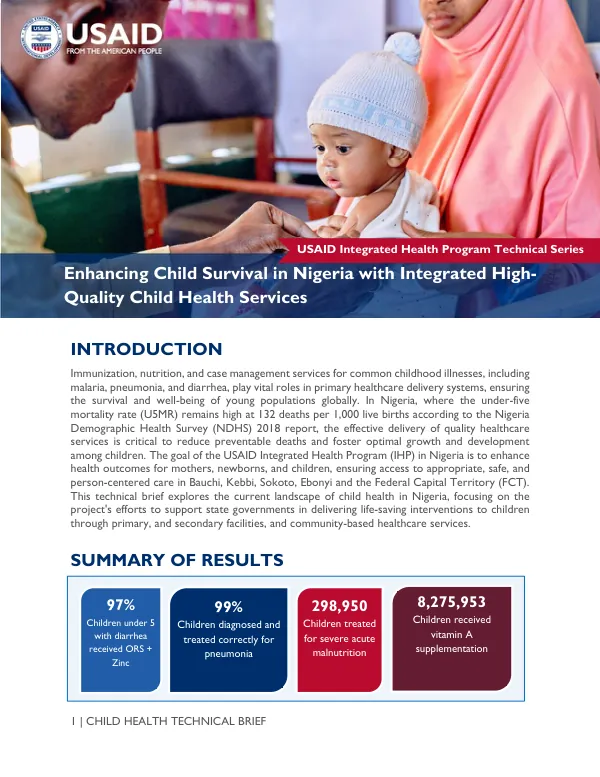
The USAID Integrated Health Program (IHP) in Nigeria aimed to enhance health outcomes for mothers, newborns, and children by ensuring access to appropriate, safe, and person-centered care in Bauchi, Kebbi, Sokoto, Ebonyi, and the Federal Capital Territory (FCT).
2024 · 12 pages
Sign in to readA free account is required to download.
Abstract
The program focused on delivering life-saving interventions to children through primary, secondary facilities, and community-based healthcare services. The under-five mortality rate (U5MR) in Nigeria remains high at 132 deaths per 1,000 live births, according to the Nigeria Demographic Health Survey (NDHS) 2018 report. This represents a 25-fold increased risk compared to higher-income countries. To address this issue, IHP implemented multiple approaches, including policy updates, capacity building for health care workers, facilitating PHC extension services to communities, improving health data reporting and use for decision-making, and improving commodities logistics for essential medicines. IHP enhanced Child Health, Immunization, Nutrition, and Malaria (CHINM) outcomes by fostering sustainable leadership and capacity building at national, state, Local Government Area (LGA), and facility levels. The program trained and mentored health care workers, health managers, and civil society organizations to spearhead and provide high-quality services. IHP also facilitated the harmonization of the Health Management Information System (HMIS) and Maternal Perinatal Child Death Surveillance Review (MPCDSR) data platforms to improve the use of data and evidence for decision-making at PHCs. Routine Monitoring and Mentoring Visits (RMMV) was a key strategy implemented by IHP to provide continuous support to healthcare providers for enhanced integrated service delivery, including delivery of child health services. During RMMV visits, supervisors used standardized checklists tailored to specific needs, capturing best practices, and assessing facility readiness. Immediate on-the-job training and action plans were provided if issues were identified, minimizing the need for classroom sessions, and reinforcing good practices. Onsite training and mentoring was also a key component of IHP's approach, following a mentoring hands-on, onsite, learning-by-doing philosophy. Adult learners excel when they engage in real-life simulations, practice with mentorship, and participate in shorter 'doses' of training with more frequent intervals. The onsite group training offered a chance for participants to digest and practice what they had learned, while raising questions and roadblocks to teammates and mentors. The program achieved significant results, including a 97% coverage of children under 5 with diarrhea receiving ORS + Zinc, 298,950 children treated for severe acute malnutrition, and 99% of children receiving vitamin A supplementation. The program also strengthened local capacity through training, on-the-job clinical and management mentoring at primary and secondary facilities and among Patent Proprietary Medical Venders (PPMVs) and Community Pharmacists (CPs). IHP's interventions included capacity building for health care workers, developing policy and clinical guidelines to improve care provision at PHCs, quality improvement interventions, and supporting the facility-management of lifesaving commodities and basic equipment. The program also facilitated the harmonization of the Health Management Information System (HMIS) and Maternal Perinatal Child Death Surveillance Review (MPCDSR) data platforms to improve the use of data and evidence for decision-making at PHCs. The program's results demonstrate the effectiveness of IHP's approach in improving child health outcomes in Nigeria. The program's focus on capacity building, quality improvement, and data-driven decision-making has contributed to a significant reduction in under-five mortality rates and improved access to quality healthcare services for mothers, newborns, and children.