USAID DEC
Understanding family planning outcomes in northwestern Nigeria: analysis and modeling of social and behavior change factors
Sign inMICHIGAN STATE UNIVERSITY FOUNDATION
Understanding family planning outcomes in northwestern Nigeria: analysis and modeling of social and behavior change factors
Northwestern Nigeria faces a situation of high fertility and low contraceptive use, driven in large part by high-fertility norms, pro-natal cultural and religious beliefs, misconceptions about contraceptive methods, and gender inequalities.
2021 · 20 pages
Sign in to readA free account is required to download.
Abstract
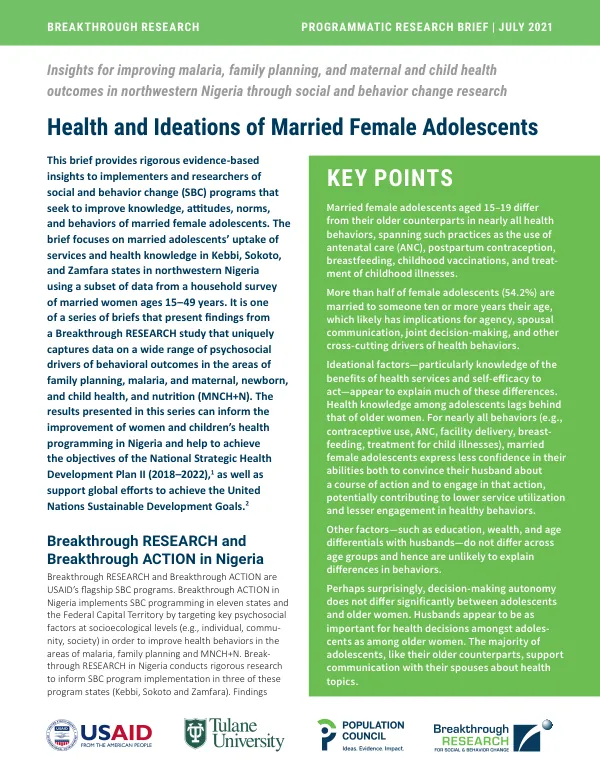
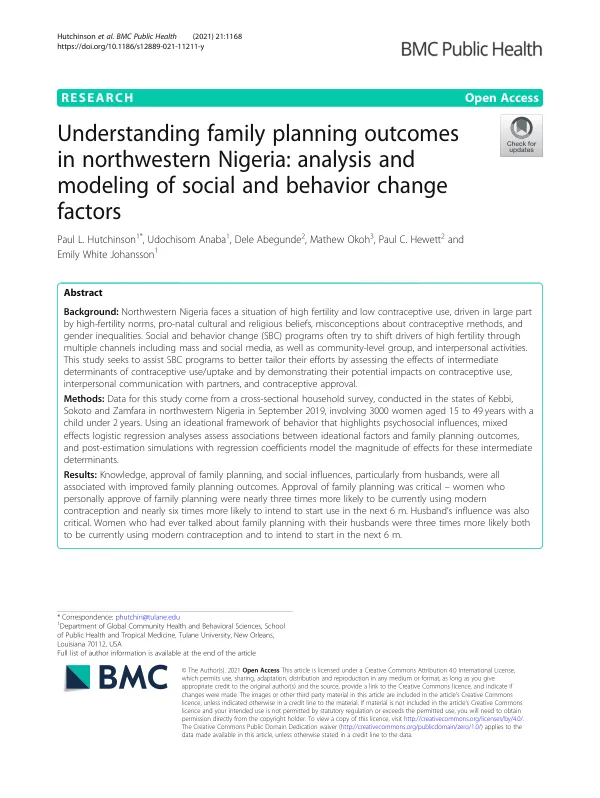
The region has one of the highest fertility rates in the world, with the total fertility rate in the northwest of the country being 6.6 live births per woman. Women aged 40 to 49 years averaged 8.3 births in their reproductive lifetimes, placing them at greater risk of birth complications and maternal mortality. The desire for large families is extensive in this region, reflected in a mean ideal number of children of 7.5. This is nearly three children more than the ideal in the south of the country. Even among high parity couples, the desire to continue having children prevails. Social norms driving high fertility in the northwest are tied in part to perceptions of its social advantages, such as signaling greater wealth and status, ensuring the survival of family names, and broadening social networks and influence. Religious beliefs also drive high fertility in the north, where the majority of the population is Muslim. Many women believe that high fertility honors Allah, and that having several children will secure the future of Islam. Misconceptions and negative perceptions about family planning use, such as beliefs that contraceptives are dangerous to a woman's health, also affect high fertility rates in northwestern Nigeria. Gender power imbalances, fostered by patriarchal social structures in which women have limited autonomy over most decisions, including those affecting marriage, health, and fertility, also drive fertility in northwestern Nigeria. Men are often the final decision-makers on important household matters, including those related to family size and contraceptive use. The low levels of female education and patterns of early marriage exacerbate power differentials, with women being valued largely for their reproductive functions. The median age at first marriage is approximately 15.9 years, and the median age for men is 25.3 years, revealing considerable age differences and hence power differentials. In this context, women are often seen as having many children as a way to ensure marital stability, protection, and financial support from their spouse. The distribution of resources and wealth in polygynous marriages is also based on the number of children a wife has, limiting incentives to use contraception. A cross-sectional household survey conducted in the states of Kebbi, Sokoto, and Zamfara in northwestern Nigeria in September 2019 involved 3000 women aged 15 to 49 years with a child under 2 years. The survey aimed to assess the effects of intermediate determinants of contraceptive use and demonstrate their potential impacts on contraceptive use, interpersonal communication with partners, and contraceptive approval. Using an ideational framework of behavior that highlights psychosocial influences, mixed effects logistic regression analyses assessed associations between ideational factors and family planning outcomes. The results showed that knowledge, approval of family planning, and social influences, particularly from husbands, were all associated with improved family planning outcomes. Approval of family planning was critical, with women who personally approved of family planning being nearly three times more likely to be currently using modern contraception and nearly six times more likely to intend to start use in the next 6 months. Husband's influence was also critical, with women who had ever talked about family planning with their husbands being three times more likely both to be currently using modern contraception and to intend to start in the next 6 months. SBC programs interested in improving family planning outcomes could potentially achieve large gains in contraceptive use, even without large-scale changes in socio-economic and health services factors, by designing and implementing effective SBC interventions that improve knowledge, encourage spousal/partner communication, and work towards increasing personal approval of family planning.
Related documents