USAID DEC
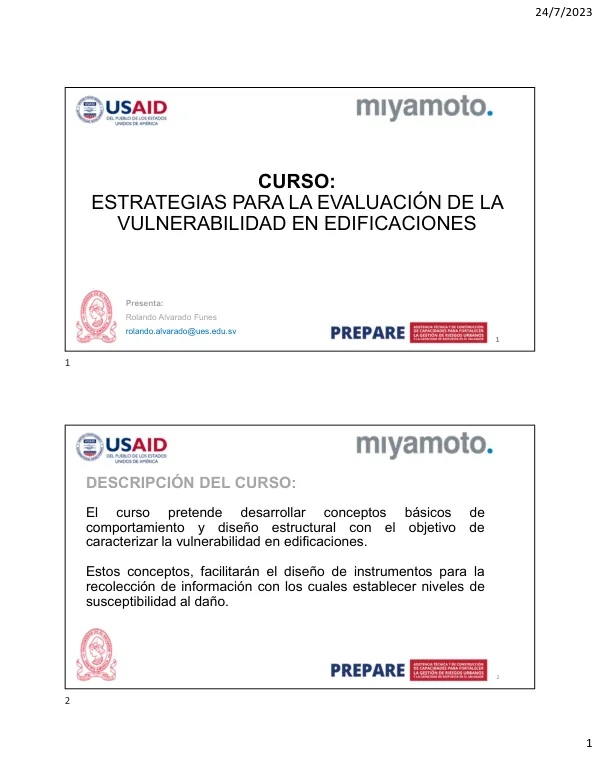
Estrategias para la Evaluación de la Vulnerabilidad en Edificaciones
The evaluation of vulnerability in buildings is a critical aspect of disaster risk management.
2023 · 67 pages
Sign in to readA free account is required to download.
Abstract
The concept of vulnerability refers to the predisposition or susceptibility of a building to be affected and suffer damage given the occurrence of a particular event of a certain magnitude. This concept is essential in the standard formulation of risk assessment, which is represented by the equation R = H × V × E, where R is the risk, H is the hazard, V is the vulnerability, and E is the exposed elements. The evaluation of vulnerability in buildings is a complex process that involves understanding the behavior and structural design of buildings. It requires the development of basic concepts related to behavior and structural design, with the objective of characterizing vulnerability in buildings. These concepts facilitate the design of instruments for collecting information to establish levels of susceptibility to damage. The course "Estrategias para la Evaluación de la Vulnerabilidad en Edificaciones" aims to develop skills for recognizing susceptibilities to damage in buildings due to earthquakes. The course covers various topics, including the effects of earthquakes, the behavior of buildings, and the evaluation of vulnerability. The course also includes practical exercises and case studies to apply the concepts learned. The effects of earthquakes on buildings can be devastating, resulting in significant economic losses, displacement, and loss of life. According to the United Nations Office for Disaster Risk Reduction (UNDRR), there are 55 earthquakes per day, resulting in economic losses of $2.245 trillion and 1.3 million deaths between 1998 and 2017. The effects of earthquakes can be categorized into several types, including ground displacement, liquefaction, tsunamis, and structural damage. Ground displacement refers to the movement of the ground surface during an earthquake, which can cause significant damage to buildings. Liquefaction occurs when the shaking of an earthquake causes water-saturated soil to lose its strength, leading to the collapse of buildings. Tsunamis are large ocean waves caused by earthquakes, which can result in widespread destruction and loss of life. Structural damage refers to the damage caused to the building's structure, which can lead to collapse and loss of life. The evaluation of vulnerability in buildings involves identifying potential impacts, planning preventive interventions, and managing resources during an emergency. The process involves several steps, including the collection of information, the definition of vulnerability models, and the evaluation of damage. The tools used for collecting information should contain the same information, regardless of the hazard. The course "Estrategias para la Evaluación de la Vulnerabilidad en Edificaciones" provides a comprehensive understanding of the evaluation of vulnerability in buildings, including the effects of earthquakes, the behavior of buildings, and the evaluation of vulnerability. The course aims to develop skills for recognizing susceptibilities to damage in buildings due to earthquakes and provides practical exercises and case studies to apply the concepts learned. The course covers various topics, including the effects of earthquakes, the behavior of buildings, and the evaluation of vulnerability. The course also includes practical exercises and case studies to apply the concepts learned. The course is designed to provide a comprehensive understanding of the evaluation of vulnerability in buildings, which is essential for disaster risk management. The course aims to develop skills for recognizing susceptibilities to damage in buildings due to earthquakes. The course provides a comprehensive understanding of the evaluation of vulnerability in buildings, including the effects of earthquakes, the behavior of buildings, and the evaluation of vulnerability. The course is designed to provide a comprehensive understanding of the evaluation of vulnerability in buildings, which is essential for disaster risk management.