USAID DEC
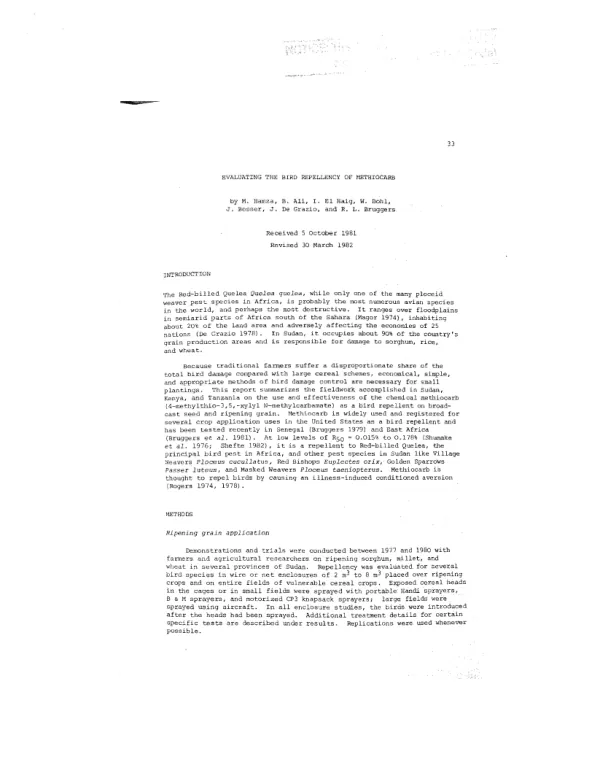
EVALUATING THE BIRD REPELLENCY OF METHIOCARB
The Red-billed Quelea, a species of bird, is considered one of the most numerous and destructive bird species in Africa.
9 pages
Sign in to readA free account is required to download.
Abstract
It inhabits approximately 20% of the land area south of the Sahara and affects the economies of 25 nations. In Sudan, the Quelea occupies about 90% of the country's grain production areas and is responsible for damage to sorghum, rice, and wheat. The use of methiocarb, a chemical repellent, has been evaluated as a means of reducing damage by Queleas and other bird species to cereals. Methiocarb is widely used and registered for several crop application uses in the United States as a bird repellent. At low levels of 0.015% to 0.178%, methiocarb is a repellent to Red-billed Queleas and other pest species in Sudan, including Village Weavers, Red Bishops, Golden Sparrows, and Masked Weavers. Fieldwork was conducted in Sudan, Kenya, and Tanzania to evaluate the effectiveness of methiocarb as a bird repellent on broadcast seed and ripening grain. In Sudan, demonstrations and trials were conducted between 1977 and 1980 with farmers and agricultural researchers on ripening sorghum, millet, and wheat in several provinces. Repellency was evaluated for several bird species in wire or net enclosures placed over ripening crops and on entire fields of vulnerable cereal crops. The results of the fieldwork showed that methiocarb was effective in reducing damage by Queleas and other bird species to cereals. In one test near Jodah, excellent protection was achieved with 1 to 3 kg of methiocarb/ha head sprays. The birds consumed from 20 to 43 g of alternative food in the untreated enclosures compared with 60 g in the treated enclosure. Methiocarb was toxic to both species, particularly at the 3 kg/ha level, as 43% of the 54 Village Weavers and 30% of the 40 Queleas died. Aerial application of methiocarb was also evaluated, but the results were inconclusive due to application problems. However, the same concentration, when applied to sorghum with a knapsack sprayer, resulted in good protection. The effectiveness of methiocarb was also evaluated in Kenya, Tanzania, and Sudan, where it was found to be effective in reducing damage by Queleas and other bird species to wheat fields. The use of methiocarb as a bird repellent has been demonstrated to be effective in reducing damage by Queleas and other bird species to cereals. The results of the fieldwork suggest that methiocarb can be used as a means of controlling bird damage to cereals in Africa.