AVENIR HEALTH
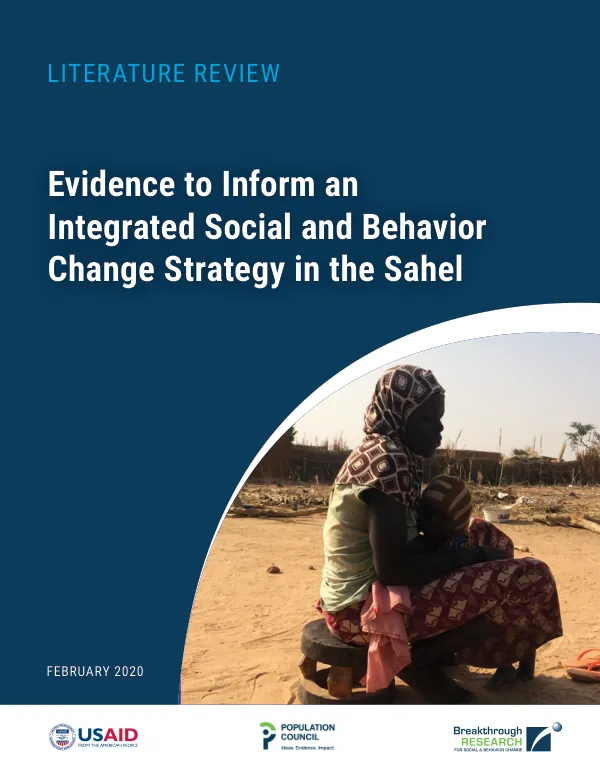
Evidence to Inform an Integrated Social and Behavior Change Strategy in the Sahel
The Sahel region, covering the lower Sahara to the north African savannah, experiences persistent poverty, recurrent climate shocks, high population growth, and food insecurity.
2020 · 22 pages
Sign in to readA free account is required to download.
Abstract
Approximately half of the population lives in poverty, defined as living on less than $2 per day. Violent extremism is reportedly increasing as resources become more constrained amid weak or corrupt governance. Chronic poverty results in a need for external humanitarian assistance during droughts and an inability to recover after a drought or other type of climate shock. While the Sahel region contributes little to greenhouse gas emissions, its temperatures are rising 150% faster than the global average. Consequences of climate change are extreme temperatures, fluctuating rainfall, and droughts, affecting water supply for the human and animal populations in addition to agriculture, leading to food insecurity. These worsening conditions are often associated with humanitarian emergencies, including famine, displacement, and conflict. In the Sahel, 33 million people are classified as food insecure, with 4.9 million displaced in 2018 alone, and 24 million require humanitarian assistance, including 4.7 million children under the age of five who are suffering from acute malnutrition. A high proportion of children are stunted, with 35% in Burkina Faso and 44% in Niger. Under-five mortality rates are also high, with 76 per 1,000 births in Burkina Faso and 84 per 1,000 in Niger. Large numbers of children within families are seen as a risk management strategy in response to the cycle of shocks and stressors households face in such a harsh climate. The total fertility rate in Burkina Faso is 5.2 births per woman, and 7.6 in Niger, which is the highest in the world. Niger has the fastest-growing population in the world, with a growth rate of 3.8% each year. The Sahel region's health and development challenges are significant, with priority health behaviors and their determinants requiring attention. Breakthrough RESEARCH's mixed-methods research will assess the successes and challenges of integrated social and behavior change (SBC) programming, including its effectiveness in promoting priority behaviors and its cost-effectiveness. The review of the literature on SBC programming summarizes the evidence and lack thereof in the Sahel to establish a rationale for the planned Breakthrough RESEARCH RISE II SBC evaluation. The RISE initiative was developed in 2012 to strategically address the health and development challenges in the Sahel region. The initiative aims to improve the resilience of vulnerable populations in the Sahel by addressing the root causes of poverty, hunger, and conflict. The RISE initiative focuses on improving access to health services, increasing agricultural productivity, and enhancing the resilience of communities to climate-related shocks. Determinants of priority behaviors targeted to improve health outcomes in the Sahel include poverty, lack of access to education, and limited access to healthcare services. These determinants are closely linked to the region's health and development challenges, including high under-five mortality rates, stunting, and acute malnutrition. Evidence from SBC programs in the Sahel suggests that interpersonal communication with supporting print materials can be an effective approach to promoting priority behaviors. Mass media approaches have also been used to promote SBC programs in the region. However, the evidence on the effectiveness of these approaches is limited, and further research is needed to establish the best practices for SBC programming in the Sahel. Integrated SBC programs have been implemented in the Sahel region, combining multiple approaches to promote priority behaviors. These programs have shown promising results, but the evidence on their effectiveness is limited, and further research is needed to establish the best practices for integrated SBC programming in the region.
Related documents