ECO CONSULTING GROUP
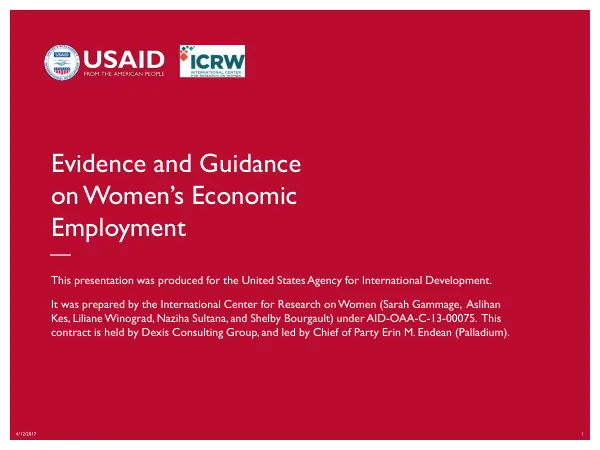
Evidence and Guidance on Women’s Economic Employment
Despite progress, gender gaps remain in labor markets in both developing and developed countries.
2017 · 12 pages
Sign in to readA free account is required to download.
Abstract
Fewer women work in paid employment compared to men, and women frequently earn less income for similar work. Women cluster in more precarious, lower value-added sectors and part-time employment. Social norms, discrimination, legal barriers to mobility, and gender-based violence limit women's ability to participate in labor markets on equal terms with men. Labor market segmentation by sector reveals significant disparities. In East Asia and the Pacific, women are underrepresented in manufacturing and agriculture, while in Europe and Central Asia, they are overrepresented in the service sector. Women's participation in the informal sector is also higher than men's in many regions, including East Asia and the Pacific and South Asia. The gender wage gap persists, with women earning 18% less than men in some countries. Supply-side initiatives focus on workforce development and education and training, improving the quality of the labor supply. Intermediation services aim to improve labor market coordination and better match demand and supply. Demand-side initiatives stimulate labor demand and provide incentives for hiring and retention of workers. Labor market institutions and social protection affect the enabling environment in which men and women work and can influence the decision to work and the experience of work. Evidence from various programs demonstrates the effectiveness of targeted interventions. In Colombia, women offered training earned about 18 percent more than those not offered training through the Youth in Action (Jovenes en Acción) training program for disadvantaged youth. In India, a job-placement program connected rural women with jobs in the business process outsourcing industry, leading to increased employment and interest in working throughout their lives. In Kenya, the government established a Commonwealth Business Women's Academy to train women and women-owned businesses on how to take advantage of business opportunities through procurement.
Related documents