POPULATION COUNCIL
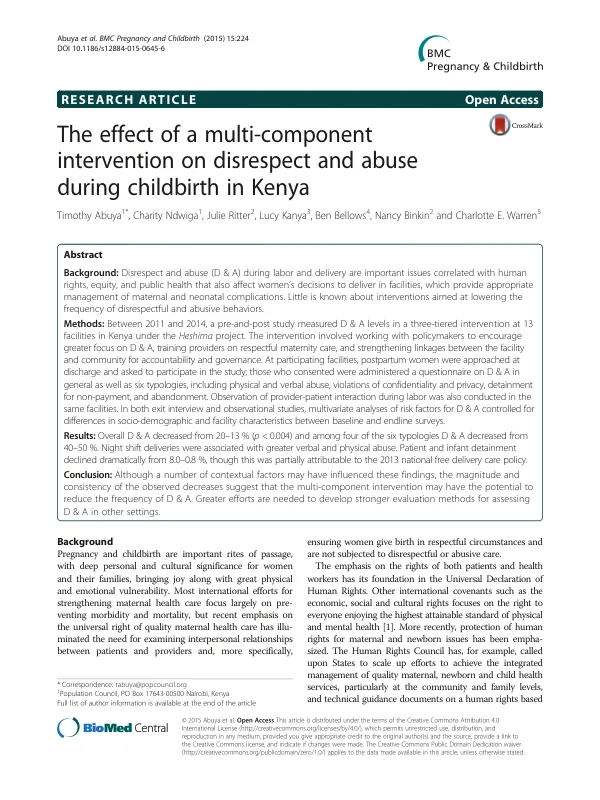
Exploring the Prevalence of Disrespect and Abuse during Childbirth in Kenya
The prevalence of disrespect and abuse during childbirth in Kenya is a significant concern.
2015 · 13 pages
Sign in to readA free account is required to download.
Abstract
Poor quality of care, including fear of disrespect and abuse, influences women's decisions to seek maternity care. Key manifestations of disrespect and abuse include physical abuse, non-consented care, non-confidential care, non-dignified care, discrimination, abandonment, and detention in facilities. A study conducted in thirteen Kenyan health facilities found that 20% of women reported any form of disrespect and abuse. The manifestations of disrespect and abuse included non-confidential care (8.5%), non-dignified care (18%), neglect or abandonment (14.3%), non-consensual care (4.3%), physical abuse (4.2%), and detention for non-payment of fees (8.1). Women aged 20-29 years were less likely to experience non-confidential care compared to those under 19. Clients with no companion during delivery were less likely to experience inappropriate demands for payment. Women with higher parities were three times more likely to be detained for lack of payment and five times more likely to be bribed compared to those experiencing their first birth. The skilled birth attendance rate in Kenya fell from 50% in 1989 to 44% in 2008/9, a likely contributor to the country's sustained high maternal mortality ratio. The reasons for the low levels of skilled care at birth are relatively well-understood in Kenya. A report by the Federation of Women Lawyers and the Centre for Reproductive Rights documented disrespect and abuse during childbirth, including physical abuse, non-consensual care, non-dignified care, verbal abuse, discrimination towards poor and young mothers, abandonment of women during and after labor, and detention in facilities. A landscape analysis by Bowser and Hill reviewed evidence of disrespect and abuse in facility deliveries to define the concept, identify its scope, contributing factors, and impact in childbirth, along with potential interventions. The analysis categorized disrespect and abuse into seven manifestations: physical abuse, non-consensual care, non-confidential care, non-dignified care, discrimination, abandonment of care, and detention in facilities. Key contributing factors for these behaviors are grouped as individual and community level factors normalizing disrespect and abuse, lack of legal and ethical foundations for addressing disrespect and abuse, lack of leadership, standards and accountability, and provider prejudice due to lack of training and resources. The study aimed to contextually define the types of disrespect and abuse behaviors that manifest in selected facilities in Kenya and to measure their prevalence. The study used a measurable construct of disrespect and abuse, which was developed by investigators from two USAID-TRAction funded projects. The study found that one out of five women experienced feeling humiliated during labor and delivery, and six categories of disrespect and abuse during childbirth in Kenya were reported. Understanding the prevalence of disrespect and abuse is critical in developing interventions at national, health facility, and community levels to address the factors and drivers that influence disrespect and abuse in facilities and to encourage clients' future facility utilization.