USAID DEC
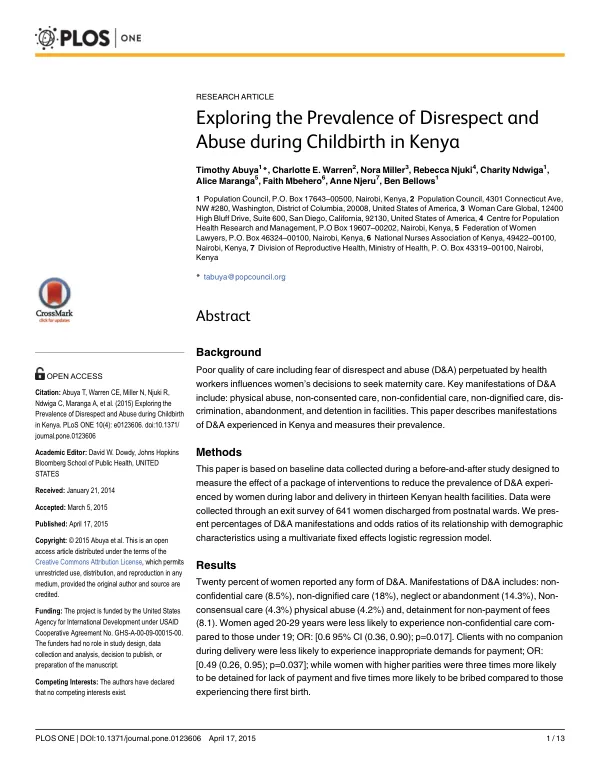
The effect of a multi-component intervention on disrespect and abuse during childbirth in Kenya
Sign inPOPULATION COUNCIL
The effect of a multi-component intervention on disrespect and abuse during childbirth in Kenya
The Heshima project in Kenya aimed to reduce disrespect and abuse (D & A) during childbirth in health facilities.
2015 · 14 pages
Sign in to readA free account is required to download.
Abstract
The project was implemented between 2011 and 2014 in 13 facilities across four counties, including Kisumu, Kiambu, Nyandarua, and Uasin Gishu, as well as a slum in Nairobi. The project's interventions were designed to address D & A at policy, facility, and community levels. At the policy level, the project involved continuous policy dialogue with government, civil society, and professional knowledge networks to build rapport and ownership and to encourage critical actors to reflect on D & A as a key component of quality maternity care. At the facility level, the core intervention elements included orientation and training on respectful maternity care for providers and managers, aimed at improving providers' attitudes and working environment and strengthening linkages between the facility and community for accountability and governance. At the community level, the core Heshima interventions included training on respectful maternity care issues, community dialogue, and counseling. Additionally, a mechanism was established to examine reported cases of D & A through a mutually agreed-upon mediator who facilitated a resolution between the woman reporting the D & A and the facility providers and management. The project's interventions were refined and replicated in seven additional facilities beginning in November 2012 and continued for 14 months. The project's design involved an iterative process of learning-by-doing throughout its development and assessment, with the objective of identifying low-cost and feasible policy, facility, and community interventions. The Kenya Demographic and Health Survey (KDHS) reported Kenya's maternal mortality ratio at an estimated 488 deaths per 100,000 live births in 2010, with only 43% of births occurring in health facilities in the previous five years. The Heshima project was implemented in response to growing policymaker awareness of the need to reduce maternal mortality and concerns over the quality of services, including front-page newspaper stories exposing health facilities' detainments of infants and their mothers for unpaid hospital fees. The project's findings showed a significant decrease in D & A from 20% to 13% (p < 0.004) and among four of the six typologies, D & A decreased from 40-50%. Night shift deliveries were associated with greater verbal and physical abuse, while patient and infant detainment declined dramatically from 8.0-0.8%, although this was partially attributable to the 2013 national free delivery care policy. The project's results suggest that the multi-component intervention may have the potential to reduce the frequency of D & A. However, greater efforts are needed to develop stronger evaluation methods for assessing D & A in other settings. The project's findings highlight the importance of addressing D & A through a human rights lens and a quality of care lens, and the need for broader societal contributions at both policy and community levels to reduce D & A during childbirth.