USAID DEC
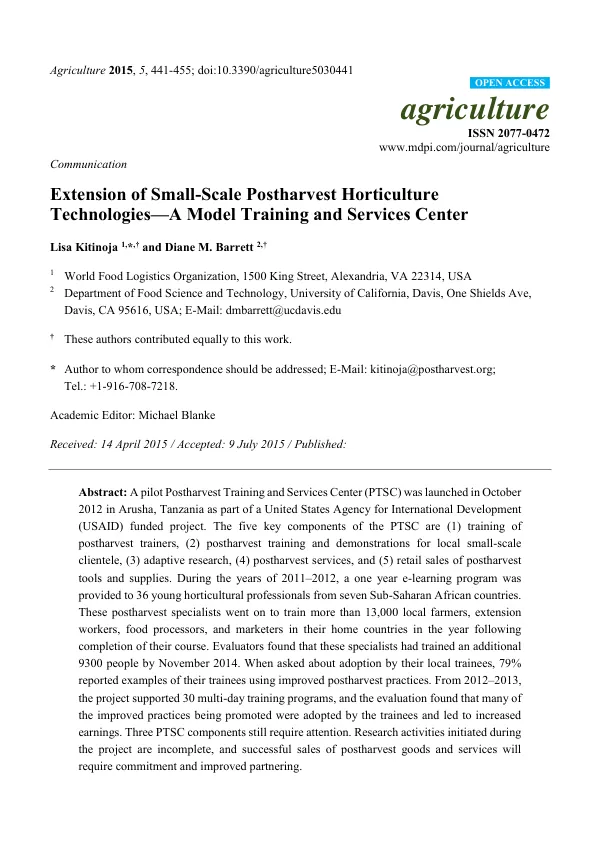
Extension of Small-Scale Postharvest Horticulture Technologies—A Model Training and Services Center
Sign inSAVE THE CHILDREN FUND
Extension of Small-Scale Postharvest Horticulture Technologies—A Model Training and Services Center
The agricultural development initiative in Tanzania began in 2012 as a pilot project funded by the United States Agency for International Development (USAID).
2015 · 16 pages
Sign in to readA free account is required to download.
Abstract
The project aimed to reduce postharvest losses in horticultural crops by providing training and support to local farmers, traders, and small-scale food processors. The initiative was part of the Horticulture CRSP (Collaborative Research Program) at the University of California, Davis. The pilot Postharvest Training and Services Center (PTSC) was launched in October 2012 on the campus of the World Vegetable Center in Arusha, Tanzania. The PTSC had five key components: training of postharvest trainers, postharvest training and demonstrations for local clientele, adaptive research, postharvest services, and retail sales of postharvest tools and supplies. During the project's first year, a one-year e-learning program was provided to 36 young horticultural professionals from seven Sub-Saharan African countries. These professionals went on to train more than 13,000 local farmers, extension workers, food processors, and marketers in their home countries. By 2014, these specialists had trained an additional 9,300 people. The project's focus was on reducing postharvest losses in horticultural crops, which are estimated to be around 44% of the total global production weight. In Sub-Saharan Africa, postharvest losses are reported to be even higher, ranging from 40% to 80% for many crops. The PTSC was designed to serve as a site for training and support for local farmers, traders, and small-scale food processors. The center provided training on improved produce handling, sorting, grading, cooling, storage, and processing practices. The project also aimed to promote the use of postharvest technologies and tools, such as improved packages and market information. The project's impact evaluation showed that many of the trainees adopted improved practices and reported increased earnings. However, the research activities initiated during the project were incomplete, and successful sales of postharvest goods and services required commitment and improved partnering. The project's findings highlighted the need for enhanced funding for research and extension, updating markets, access to credit, support for associations, and training of women as extension agents. The PTSC model was developed as a response to the lack of postharvest training and support for farmers, traders, and small-scale food processors in developing countries. The project's results showed that the PTSC model was effective in reducing postharvest losses and promoting the use of postharvest technologies and tools. The model's success was attributed to the provision of training and support to local farmers, traders, and small-scale food processors. The project's findings have implications for the development of postharvest extension programs in other countries. The project's impact evaluation also highlighted the need for further research on postharvest losses and the development of postharvest technologies and tools. The PTSC model has the potential to be replicated in other countries, and its success has implications for the reduction of postharvest losses and the promotion of sustainable agriculture practices.