USAID
F2F Standard Indicator Table 3: Reporting on Outcomes and Impacts
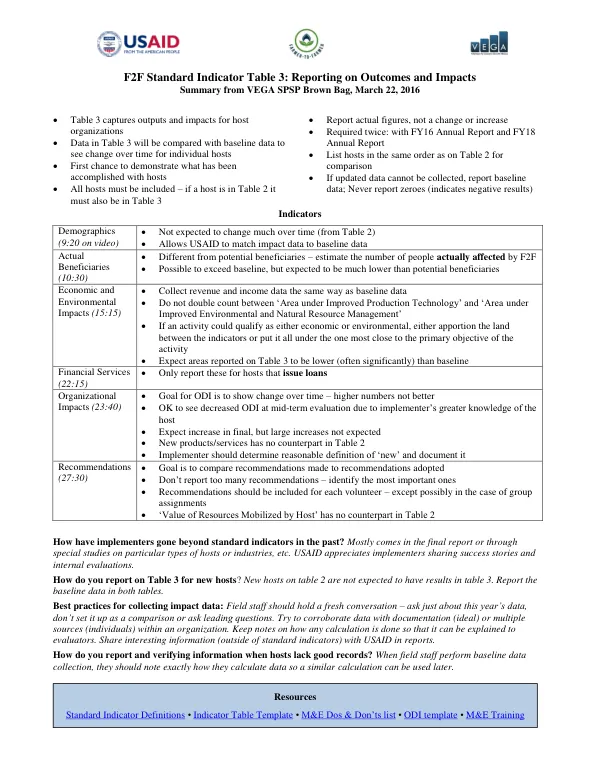
F2F Standard Indicator Table 3 captures outputs and impacts for host organizations.
2016 · 1 pages
Sign in to readA free account is required to download.
Abstract
Data in this table is compared with baseline data to see change over time for individual hosts. This table provides the first opportunity to demonstrate what has been accomplished with hosts. All hosts must be included in this table, and actual figures must be reported, not changes or increases. This table is required twice: with the FY16 Annual Report and the FY18 Annual Report. Hosts are listed in the same order as on Table 2 for comparison. If updated data cannot be collected, baseline data is reported. Zeroes are never reported, as they indicate negative results. The indicators on Table 3 include demographics, actual beneficiaries, economic and environmental impacts, financial services, and organizational impacts. Demographics are not expected to change much over time and allow USAID to match impact data to baseline data. Actual beneficiaries are estimated to be the number of people actually affected by F2F, which is often lower than potential beneficiaries. Economic and environmental impacts are collected and reported in the same way as baseline data, with the exception of not double-counting between 'Area under Improved Production Technology' and 'Area under Improved Environmental and Natural Resource Management'. Financial services are only reported for hosts that issue loans, and organizational impacts are reported to show change over time. The goal for Organizational Development Indicators (ODI) is to show change over time, with higher numbers not necessarily being better. Implementers are encouraged to share success stories and internal evaluations, and to report on Table 3 for new hosts by reporting baseline data in both tables. Best practices for collecting impact data include holding a fresh conversation with field staff, asking about this year's data, and corroborating data with documentation or multiple sources within an organization. Notes should be kept on how any calculation is done so that it can be explained to evaluators.