SAMARITAN'S PURSE
FABRIC Baseline Report
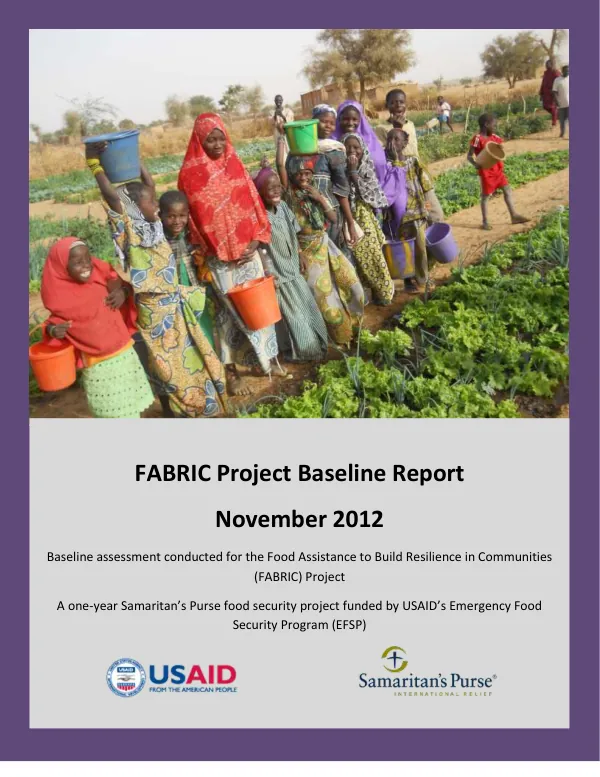
Food Assistance to Build Resilience in Communities (FABRIC) Project is an emergency food security project focused on building resilience by decreasing levels of vulnerability to food insecurity in the Northern Tillabéry Region of Niger.
2012 · 36 pages
Sign in to readA free account is required to download.
Abstract
The project aims to increase the year-round availability of food at the household level and improve dietary diversity. The project is implemented in four communes, with a total of 20 communities where off-season gardening activities will take place, 20 borehole sites to aid in gardening activities, and 5 wells to be rehabilitated throughout the target communes. The baseline assessment identified key findings, including the majority of households experiencing moderate or severe hunger, with 68% of households adopting a survival coping mechanism. Only 12.8% of households had adequate dietary diversity, and half of the households had consumed vegetables in the previous seven days. These results are presented in Figure 1, which shows the baseline level of the eight project results indicators by commune. The project's two main objectives are to increase the year-round availability of food at the household level and improve dietary diversity. The project's results indicators include the percentage of households that eat at least three meals a day, the percentage of households with moderate or severe hunger, the percentage of households adopting a survival coping mechanism, the percentage of households that know at least six good nutritional practices, and the percentage of households that produce their own vegetables from garden plots. The baseline assessment used a Lot Quality Assurance Sampling (LQAS) methodology to establish the baseline level of the eight project results indicators. The assessment was conducted directly after the annual harvest, which may have influenced the results. The results indicate that the project has a significant impact on the beneficiary population, with a 27% increase in the percentage of households that eat at least three meals a day and a 25% decrease in the percentage of households with moderate or severe hunger. The project's implementation is focused on four key interventions: farmer training, infrastructure development, market linkage facilitation, and community feedback. The project's results indicate that the interventions have been successful in improving the food security of the beneficiary population. The project's performance indicators and targets are revised based on the findings of the baseline assessment. The project's results framework is presented in Appendix A, which outlines the project's objectives, results indicators, and indicators tracking table. The project's indicator tracking table is presented in Appendix B, which outlines the project's results indicators and targets. The project's baseline survey questionnaires are presented in Appendix C, which outlines the survey methodology and data collection and analysis. The project's implementation is expected to continue for the life of the project, with a total duration of 24 months. The project's results are expected to be monitored and evaluated regularly, with a final evaluation conducted at the end of the project. The project's findings and recommendations will be used to inform future food security projects in the region.
Related documents