USAID
Resilience in the Sahel Enhanced (RISE)
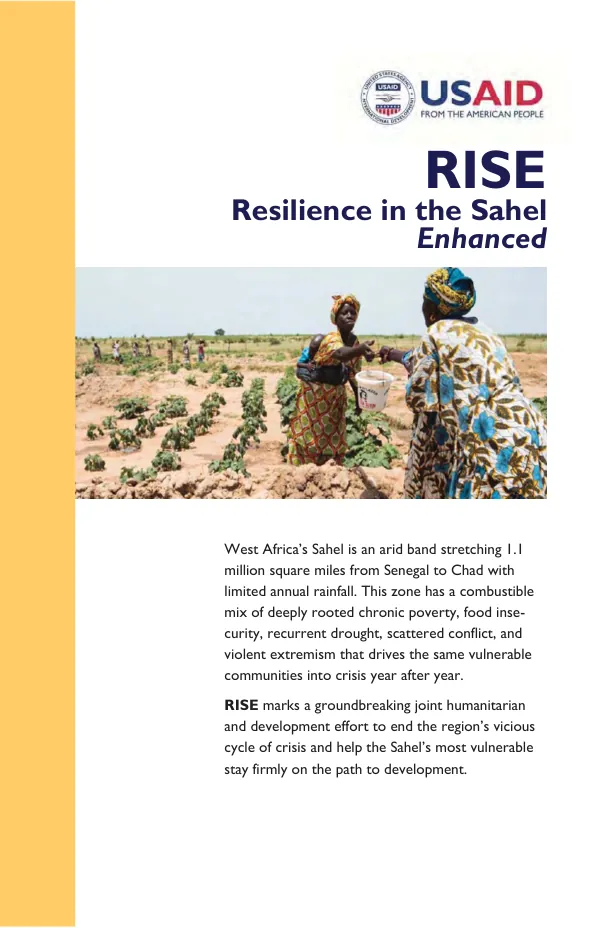
The Sahel region in West Africa is a 1.1 million square mile arid band stretching from Senegal to Chad, characterized by limited annual rainfall and a mix of chronic poverty, food insecurity, recurrent drought, scattered conflict, and violent extremism.
2014 · 4 pages
Sign in to readA free account is required to download.
Abstract
This combustible environment drives vulnerable communities into crisis year after year. The Sahel has experienced recurrent droughts, with the 2012 drought throwing more than 18 million people into severe food insecurity and nutrition crisis. Many communities are still struggling to recover from previous droughts, and millions are currently food insecure, with 1.5 million at risk of severe acute malnutrition. The region faces high childhood malnutrition and underdevelopment, making it vulnerable to shocks from climate change. Building resilience, including more inclusive governance and stronger livelihoods, is crucial to help the Sahel's most vulnerable populations cope with the next shock and break out of chronic poverty. The Resilience in the Sahel Enhanced (RISE) initiative, a new USAID effort, aims to address the root causes of persistent vulnerability by bringing together humanitarian and development assistance. RISE commits over $130 million in new assistance over the first two years of a five-year effort to build resilience in targeted zones in Niger and Burkina Faso. The initiative focuses on strengthening institutions and governance, increasing sustainable economic wellbeing, and improving health and nutrition in selected geographic zones. These investments will be layered, sequenced, and integrated with existing humanitarian and development assistance to give an estimated 1.9 million of the area's most vulnerable a real chance to break the cycle of crisis and lessen the need for humanitarian assistance in the future. In addition to Niger and Burkina Faso, RISE will leverage existing U.S. humanitarian and development assistance in close coordination with civil society, local governments, NGOs, the United Nations, and other international development partners in four other countries in the Sahel: Senegal, Mali, Mauritania, and Chad. The initiative aims to fundamentally change the equation on extreme poverty by supporting country-led plans and bringing together relief and development partners across sectors.