DEPARTMENT FOR INTERNATIONAL DEVELOPMENT
Fast Facts: President's Malaria Initiative (PMI)
The President's Malaria Initiative (PMI) was launched in 2005 with a five-year plan to reduce the burden of malaria in sub-Saharan Africa.
2013 · 4 pages
Sign in to readA free account is required to download.
Abstract
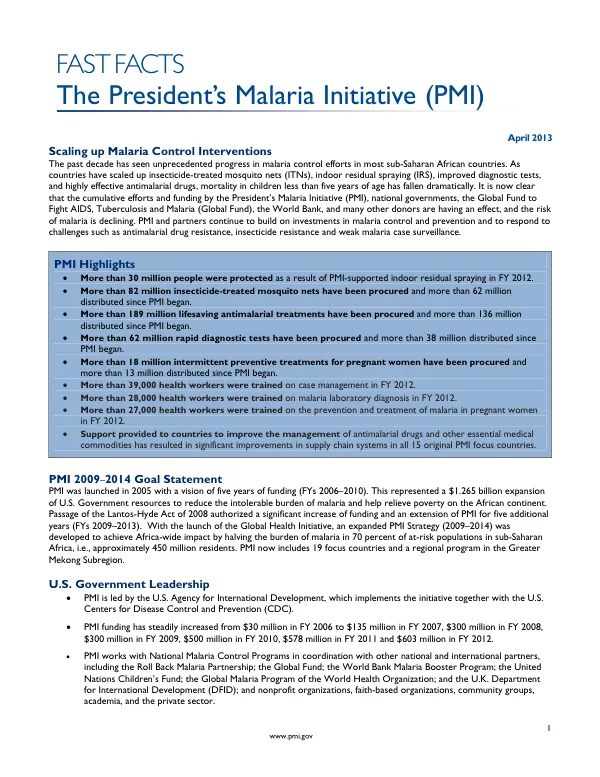
The initiative was later extended to 2014 with a new strategy to achieve a 70% reduction in malaria cases. PMI focuses on four key interventions: indoor residual spraying, insecticide-treated mosquito nets, intermittent preventive treatment for pregnant women, and diagnostic and treatment services. PMI has made significant progress in reducing malaria cases and deaths. In 2012, PMI supported the distribution of over 82 million insecticide-treated mosquito nets and over 189 million antimalarial treatments. The initiative also trained over 28,000 health workers in malaria case management and laboratory diagnosis. Nationwide household surveys conducted in PMI focus countries have shown a decline in under-five mortality rates. In Malawi, the mortality rate decreased by 16%, while in Rwanda, it decreased by 50%. Similar reductions were observed in other PMI focus countries, including Ethiopia, Ghana, Kenya, Madagascar, Mozambique, Senegal, Uganda, and Zambia. PMI's external evaluation in 2011 highlighted the initiative's planning, partnerships, and funding as key factors in combating malaria. The evaluation report recommended continued support for PMI's efforts to reduce malaria cases and deaths. PMI works with national governments, international partners, and other partners to implement its programs. The initiative has expanded its focus to include the Greater Mekong Subregion and has established a regional program. PMI's progress has been recognized by the World Health Organization and other global health organizations. The initiative's success is attributed to its strong partnerships and effective implementation of its programs. PMI's focus on reducing malaria cases and deaths has led to significant improvements in health outcomes in sub-Saharan Africa. The initiative's progress has been recognized by the global health community, and it continues to be a key player in the fight against malaria. PMI's efforts have also led to improvements in health systems and infrastructure in the countries where it operates. The initiative has supported the development of national malaria control programs and has provided training and equipment for health workers. PMI's work has also contributed to the development of new malaria treatments and diagnostic tools. In addition to its work in sub-Saharan Africa, PMI has also expanded its focus to include other regions, including the Greater Mekong Subregion. The initiative's progress has been recognized by the global health community, and it continues to be a key player in the fight against malaria.
Related documents