FHI 360
MEASURE Evaluation PIMA Factsheet
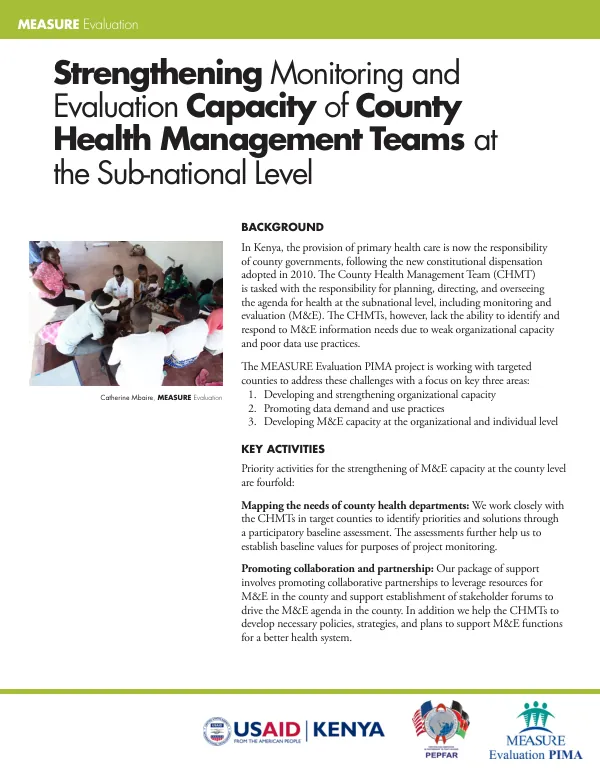
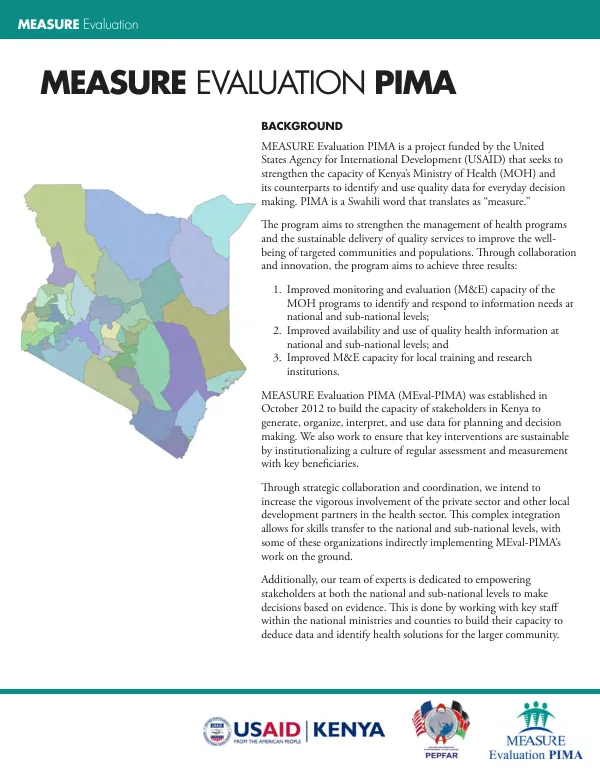
MEASURE Evaluation PIMA is a project funded by the United States Agency for International Development (USAID) that aims to strengthen the capacity of Kenya's Ministry of Health (MOH) and its counterparts to identify and use quality data for everyday decision making.
2015 · 2 pages
Sign in to readA free account is required to download.
Abstract
The program seeks to strengthen the management of health programs and the sustainable delivery of quality services to improve the well-being of targeted communities and populations. The program focuses on three key results: improved monitoring and evaluation (M&E) capacity of MOH programs, improved availability and use of quality health information, and improved M&E capacity for local training and research institutions. MEASURE Evaluation PIMA was established in October 2012 to build the capacity of stakeholders in Kenya to generate, organize, interpret, and use data for planning and decision making. The project targets four key areas for improvement: referral systems, Community Health Information Systems (CHIS), Civil Registration and Vital Statistics (CRVS), and the Reproductive and Maternal Health Services Unit (RMHSU). In these areas, the project works to assess the capacity of each program to implement M&E functions, identify and address organizational barriers, and implement tools and approaches to improve data collection and use. Baseline data have informed the development of intervention packages and tools to support stakeholders improve M&E systems and improve the functionality of the systems at hand. These tools are designed in alignment with the values of sustainability, innovation, and country-specific needs, along with integrating gender-sensitive programming for informed decision making. The project works with a number of key stakeholders, including the Ministry of Health, the Ministry of Interior and Coordination of National Government, county and sub-county government units, and local and international organizations. The aim is to achieve strengthened leadership and governance for health in Kenya, with progress in these areas enabling citizens to better access quality health services that improve the general well-being of the society and the population at large. The project's approach involves strategic collaboration and coordination, with a focus on skills transfer to the national and sub-national levels. This complex integration allows for the involvement of the private sector and other local development partners in the health sector, with some of these organizations indirectly implementing MEval-PIMA's work on the ground. The project's team of experts is dedicated to empowering stakeholders at both the national and sub-national levels to make decisions based on evidence, working with key staff within the national ministries and counties to build their capacity to deduce data and identify health solutions for the larger community. The project's work is guided by the principles of sustainability, innovation, and country-specific needs, with a focus on integrating gender-sensitive programming for informed decision making. The project's tools and approaches are designed to improve data collection and use, with a focus on strengthening M&E practices across Kenya.