USAID DEC
Fatty acids based eutectic phase change system for thermal energy storage applications
Sign inARIZONA STATE UNIVERSITY
Fatty acids based eutectic phase change system for thermal energy storage applications
The development of eutectic phase change materials (PCMs) for thermal energy storage (TES) applications has gained significant attention in recent years.
2018 · 10 pages
Sign in to readA free account is required to download.
Abstract
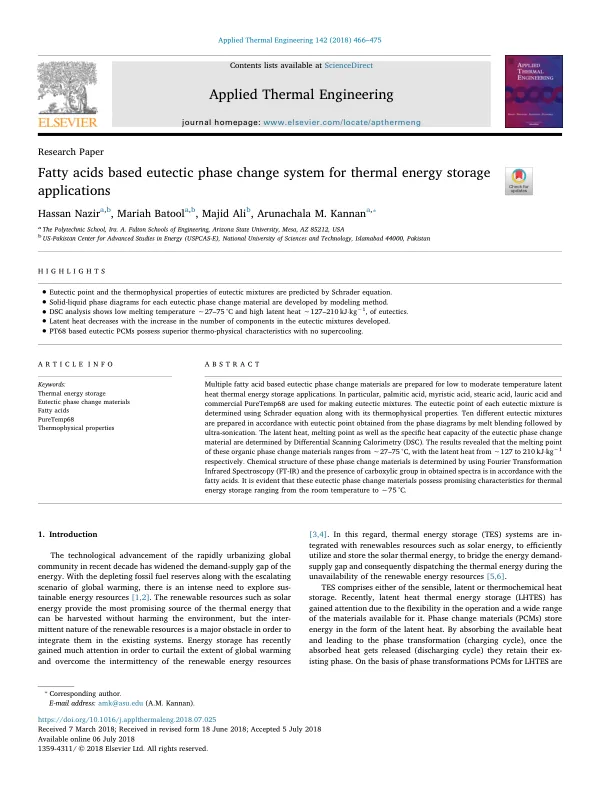
Fatty acids have been identified as a promising class of organic PCMs due to their widespread availability, environmental benignity, and low cost. In this study, a series of organic eutectic PCMs is prepared using fatty acids, including myristic acid, lauric acid, stearic acid, palmitic acid, and commercial PureTemp68. The eutectic point of each eutectic mixture is determined using the Schrader equation, along with its thermophysical properties. Ten different eutectic mixtures are prepared in accordance with the eutectic point obtained from the phase diagrams by melt blending followed by ultra-sonication. The latent heat, melting point, and specific heat capacity of the eutectic phase change material are determined by Differential Scanning Calorimetry (DSC). The results reveal that the melting point of these organic phase change materials ranges from approximately 27 to 75 °C, with the latent heat from approximately 127 to 210 kJ/kg, respectively. The chemical structure of these phase change materials is determined by using Fourier Transformation Infrared Spectroscopy (FT-IR), and the presence of a carboxylic group in the obtained spectra is in accordance with the fatty acids. It is evident that these eutectic phase change materials possess promising characteristics for thermal energy storage ranging from room temperature to approximately 75 °C. The study focuses on modeling, designing, and developing fatty acid eutectic mixtures as solid-liquid PCMs with minimal supercooling specifically for LHTES. The eutectic mixtures are prepared using four different fatty acids, namely myristic acid, lauric acid, stearic acid, and palmitic acid, along with commercial PureTemp68. The eutectic point of each eutectic mixture is determined using the Schrader equation, and the thermophysical properties are evaluated using DSC. The results show that the eutectic mixtures exhibit a wide range of thermophysical properties, including melting points, latent heats, and specific heat capacities. The study also investigates the effect of the components in the eutectic mixture on the thermophysical properties. The findings suggest that the eutectic mixtures possess superior thermophysical characteristics, including low melting temperatures and high latent heats, making them suitable for LHTES applications. The study provides extended theoretical and experimental insights on the subject by developing eutectic mass ratios, phase diagrams, and evaluating the thermophysical properties of fatty acid-based binary, ternary, quaternary, and quinary eutectic PCMs. The results of this study can be used to design and develop efficient LHTES systems for various applications, including district water heating, photovoltaic/thermal hybrid systems, space heating, thermal management of buildings, and solar thermal water heating.