USAID DEC
Feed the Future Enabling Environment for Food Security Performance Monitoring and Evaluation Plan
Sign inFINTRAC
Feed the Future Enabling Environment for Food Security Performance Monitoring and Evaluation Plan
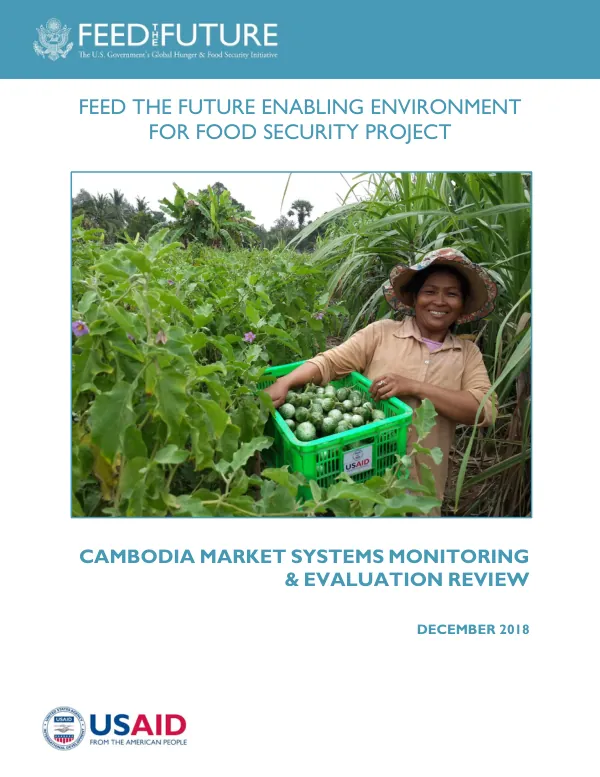
The Feed the Future Enabling Environment for Food Security mechanism was launched on September 23, 2015, by the Office of Market and Partnership Innovations (MPI) with a $13.5 million program to provide consulting services to the USAID Bureau for Food Security (BFS) and Feed the Future Focused and Aligned Missions worldwide.
2016 · 12 pages
Sign in to readA free account is required to download.
Abstract
The mechanism aims to help USAID identify, resolve, and build evidence on the constraints that limit effective agricultural markets, particularly in the enabling environment. The enabling environment refers to the structural framework of laws, regulations, and institutions that shape market design and performance. Weaknesses in basic economic rights, such as contracts, property, and the right to trade, can subvert efficient markets and competitive forces necessary for efficient exchange. The Feed the Future Enabling Environment for Food Security mechanism is designed to work in a responsive and collaborative fashion with USAID offices and Missions to build the capacity for improved enabling environment programs. Over the past five years, the Feed the Future initiative has continued to evolve the theory of change to reflect growing awareness of the complex interrelationships that affect local, national, and regional markets for agricultural commodities and food. Important developments, such as the African Union's Malabo Declaration and the Association of Southeast Asian Nations (ASEAN) Economic Community, have reshaped how we think about policy and enabling environment reform. Despite five years of success in achieving policy reform commitments, there is still a critical gap in how USAID, the Feed the Future initiative, and the donor community can most efficiently and effectively serve as a facilitator of effective reform. A growing, but still incomplete, evidence base provides guidance for reform initiatives, but often toolkits have too narrow a focus or have become outdated. The Feed the Future Enabling Environment for Food Security mechanism is designed to address this gap by providing a demand-driven vehicle for consulting services that can adapt to changing needs and priorities. The mechanism will work in a responsive and collaborative fashion with USAID offices and Missions to build the capacity for improved enabling environment programs. The project will produce separate annual work plans that provide greater specificity regarding assignments and objectives, as well as a Performance Management and Evaluation Plan for project-level indicators. The project will focus on building the capacity for improved enabling environment programs, with a particular emphasis on policy, regulatory, institutional, and market constraints that affect inclusive, sustainable food security outcomes. The project will work in a collaborative fashion with USAID offices and Missions to identify, resolve, and build evidence on the constraints that limit effective agricultural markets. The project will also provide training and technical assistance to USAID staff and partners to build their capacity for enabling environment reform. The project will be implemented over a 5-year period, with a maximum possible 5-year period of performance. The project will be guided by a 5-year strategy document outlining key project-level objectives, as well as a roadmap for the likely arc of the project's implementation. The project will review this life of project work plan annually to validate life of project objectives and to ensure that project annual work planning and assignment implementation are leading to strategic, whole-of-project objectives.