USAID DEC
Livelihoods for Resilience Learning Activity Quarterly Report July 1, 2019 to September 30, 2019
Sign inKIMETRICA LLC
Livelihoods for Resilience Learning Activity Quarterly Report July 1, 2019 to September 30, 2019
Livelihoods for Resilience Learning Activity in Ethiopia is a five-year program that aims to improve the livelihoods of chronically food-insecure households.
2019 · 5 pages
Sign in to readA free account is required to download.
Abstract
The program focuses on four key areas: on-farm income-generating activities, crop and livestock market systems; non-farm income-generating activities and nonfarm enterprise development; non-farm wage employment; and collaborative learning for scaling and sustaining gains made in the three livelihood pathways. The program is implemented by Save the Children, TANGO International, and Kimetrica, with the support of USAID's Feed the Future program. The program's goal is to increase economic growth and resilience in Ethiopia, and to reduce malnutrition. The program's objectives are to support and enhance opportunities for chronically food-insecure households in targeted woredas, and to create income-generating and value chain activities that link beneficiaries to financial services. The program's implementation is guided by a recurrent monitoring system (RMS) that provides real-time data on household resilience capacity in the face of shocks and stressors. The RMS also informs timing and targeting of interventions and early action/response. The program's baseline data collection and endline evaluation will be used to assess the program's effectiveness and impact. During the quarter from July 1 to September 30, 2019, the program partners held a series of meetings to discuss the RMS implementation, including the selection of clusters, data collection, and data analysis, and analysis of the draft questionnaire. The partners also discussed the number and frequency of focus group discussions (FGDs) and key informant interviews (KIIs) to be conducted. The draft open data kit (ODK) for the household questionnaire was prepared, finalized, and finalized. The RMS data collection was successfully completed with a 97 percent response rate, and the cleaned data was submitted in the agreed-upon formats. TANGO and Kimetrica provided training for the first round of RMS, and the data was prepared for analysis at the end of the first RMS in July 2020. For the next quarter, the program partners plan to procure services and recruit field staff, conduct training and implementation of the RMS, collect and clean data, and deliver the dataset to TANGO for analysis. The program's overall goal is to assess the program's effectiveness and impact, and to inform future interventions. The program's implementation is guided by a strong financial management system, and the partners are jointly responsible for ensuring the program's quality and accountability. The program's progress is monitored and reported quarterly, and the partners are committed to achieving the program's objectives and outcomes. The program's implementation is expected to have a positive impact on the livelihoods of chronically food-insecure households in Ethiopia, and to contribute to the country's economic growth and resilience. The program's success will depend on the effective implementation of the RMS, data collection and analysis, and analysis of the program's effectiveness and impact. The program's implementation is expected to be completed by September 1, 2021, and the program's overall goal is to improve the livelihoods of chronically food-insecure households in Ethiopia. The program's success will depend on the effective implementation of the RMS, data collection and analysis, and analysis of the program's effectiveness and impact.
Related documents
Documents in this collection
 2018
2018USAID DEC
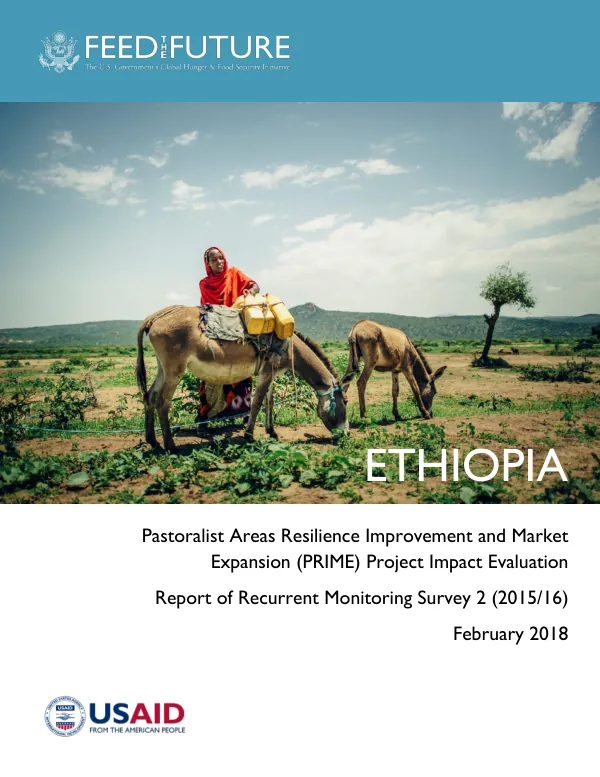
Feed the Future Ethiopia Pastoralist Areas Resilience Improvement and Market Expansion (PRIME) Project Impact Evaluation: Report of Recurrent Monitoring Survey 2 (2015/16)
Open record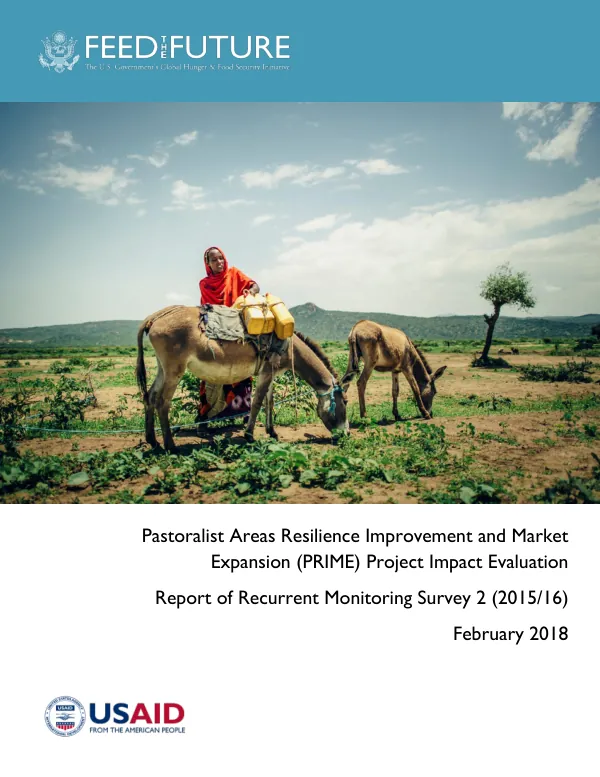 2018
2018USAID DEC