USAID DEC
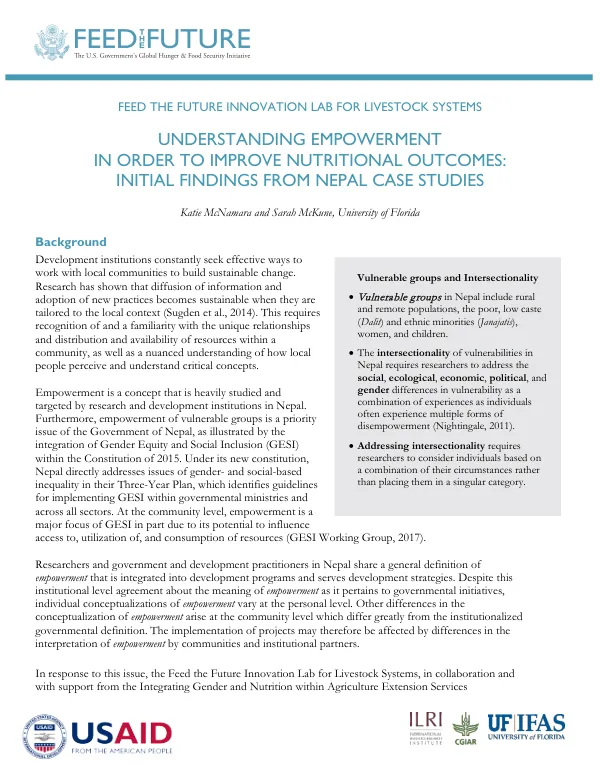
Feed the Future Innovation Lab for Livestock Systems Faculty Training Needs
The Feed the Future Innovation Lab for Livestock Systems conducted a capacity development gap analysis in Nepal to identify training and organizational development needs for improved research and teaching capacity.
2018 · 4 pages
Sign in to readA free account is required to download.
Abstract
The analysis focused on human, organizational, and environmental needs. Human capacity development is a significant concern in Nepal, particularly in terms of laboratory and practical skills. Faculty members lack knowledge, time, and materials to teach practical aspects of the curriculum, resulting in a feedback loop where students who graduate become faculty who cannot adequately teach practical skills. Updating faculty knowledge is also a challenge, with limited opportunities for faculty to update their knowledge and a cultural practice of giving priority to senior faculty for training opportunities. Community training needs in Nepal include biosecurity and WASH, business skills, developing fodder locally, farm management, fertility and reproductive management, husbandry, linking to markets, nutrition, ration balancing, and value addition. The quality of education and teaching practices varies widely, with some faculty members being highly engaging and responsive, while others rely on PowerPoints and exams. There is also a lack of community involvement from universities beyond student internships and site visits, resulting in a growing sense of frustration with the universities. Organizational capacity development is another area of concern, particularly in terms of collaboration and communication. Universities in Nepal lack adequate infrastructure, including laboratories and teaching farms, and depend heavily on collaboration with outside organizations to conduct teaching and research activities. There is a need for more collaboration for access to laboratories and farms, and formalization of collaboration with government agencies. Internal policies and procedures also affect the capacity of faculty, with a lack of accountability and a system that allows some to put forth little effort in their job versus others who put forth great effort. The enabling environment for research and extension at AFU is also a challenge, with the university struggling to meet its new mandates without an increase in funding from the Nepali government. The Department of Livestock Services is the government institution responsible for extension, putting AFU in direct conflict with DLS as a service provider. Infrastructure and material resources, including laboratories and well-resourced farms, are also lacking, resulting in an inability to update the research portfolio and a strong belief by employers and farmers that graduates lack sufficient practical skills. Library systems and information technology (IT) are also a concern, with a lack of sufficient library and information technology systems and limited capacity of the existing staff. This includes infrastructure and materials issues such as adequate computer facilities, high-speed internet, e-library tools, access to academic journals, and distance education tools. Exposure to outside institutions and ideas is also a problem, with a lack of exposure to ideas and institutions outside of Nepal, other than India, resulting in a replication of strengths and weaknesses throughout the agriculture and livestock sectors. The capacity development gap analysis identified several key areas for improvement, including updating faculty knowledge, improving laboratory and practical skills, enhancing community involvement, and strengthening organizational capacity. Addressing these gaps will require a comprehensive approach that involves training, organizational development, and infrastructure improvements.