FLORIDA INTERNATIONAL UNIVERSITY
Understanding Empowerment in Nepal: Initial Findings from Case Studies
Rural communities in Nepal exhibit a strong emphasis on family support as a source of empowerment for both men and women.
2018 · 7 pages
Sign in to readA free account is required to download.
Abstract
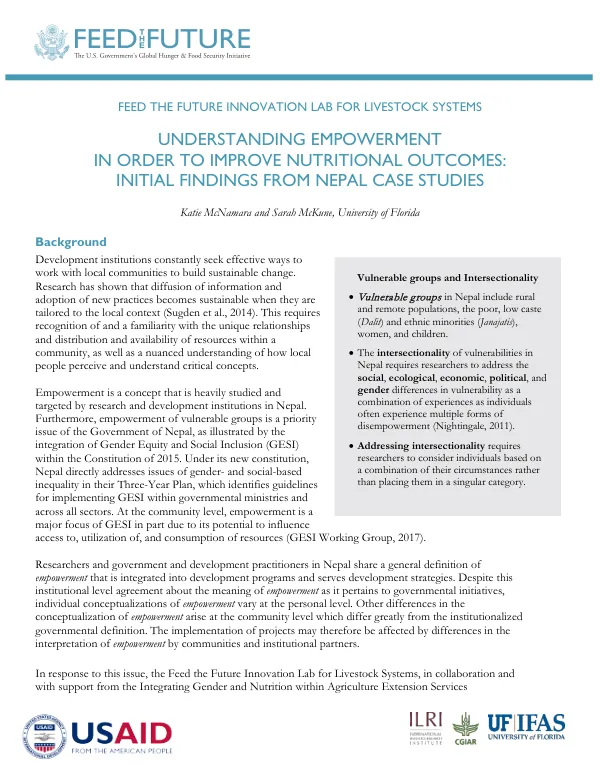
Women participants mentioned a lack of family support as a barrier to women's empowerment. Financial stability plays a significant role in empowerment of men and women according to both men and women. However, women's empowerment is hindered by a lack of financial stability, as reported by women participants. Men's empowerment is also hindered by a lack of financial stability, as reported by both men and women. Empowerment of men and women is associated with various sources, including family support, financial stability, technical skills training, and community participation. Women's empowerment is also associated with power to make decisions, while men's empowerment is associated with children's education and health. Men's empowerment is hindered by a lack of family support, as reported by men participants. The Community Concept Drawing (CCD) Methodology was used to collect data from smallholder communities and development practitioners in Nepal. The methodology involves a participatory drawing exercise in which participants are asked to illustrate their concept of empowerment. Researchers then ask participants to rank the most important enabling factors and barriers to empowerment for men and women. The CCD sessions were conducted in 3 communities in the Central Development Region (CDR) and 2 municipalities in the Western Development Region (WDR). The sessions involved 15-30 individuals, including women's groups, men's groups, and mixed groups. The CCD sessions with development practitioners included one session with a mixed participant group and one single-organization session. The CCD Methodology utilizes participatory group drawing to map and discuss concepts as they relate to the participant group. The methodology allows researchers to identify trends in asset ownership, decision-making power, diet, and family dynamics that participants associate with increased or decreased empowerment. The study aimed to understand how different conceptualizations of empowerment may influence nutritional outcomes at the community level. The Livestock Systems Innovation Lab is particularly interested in the influence of empowerment on the consumption of animal-source foods. The study also aimed to identify the sources of empowerment and barriers to empowerment for men and women in rural communities in Nepal. The study found that family support is a significant source of empowerment for both men and women in rural communities in Nepal. Financial stability plays a significant role in empowerment of men and women, but women's empowerment is hindered by a lack of financial stability. Men's empowerment is also hindered by a lack of family support. The study also found that empowerment of men and women is associated with various sources, including family support, financial stability, technical skills training, and community participation. Women's empowerment is associated with power to make decisions, while men's empowerment is associated with children's education and health. The CCD sessions were conducted in 3 communities in the Central Development Region (CDR) and 2 municipalities in the Western Development Region (WDR). The
Related documents
Documents in this collection
 2018
2018USAID DEC
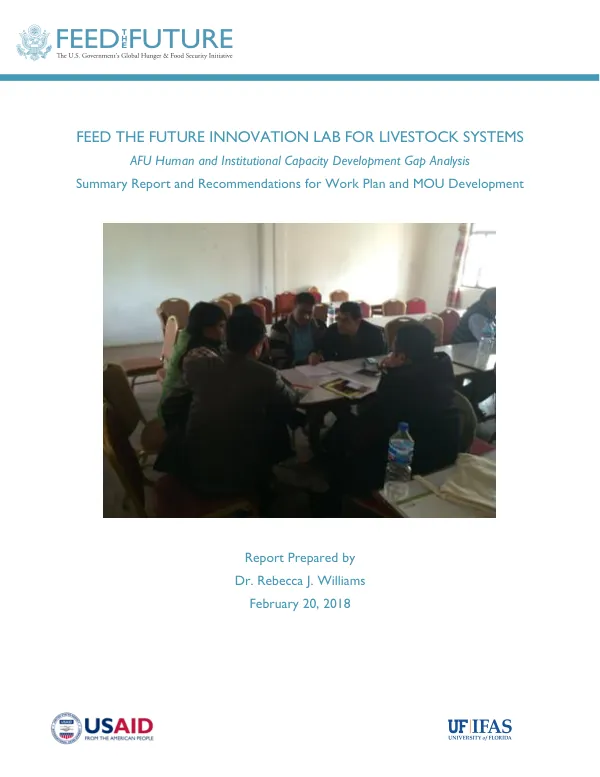
Feed the Future Innovation Lab for Livestock Systems AFU Human and Institutional Capacity Development Gap Analysis Summary Report and Recommendations for Work Plan and MOU Development
Open record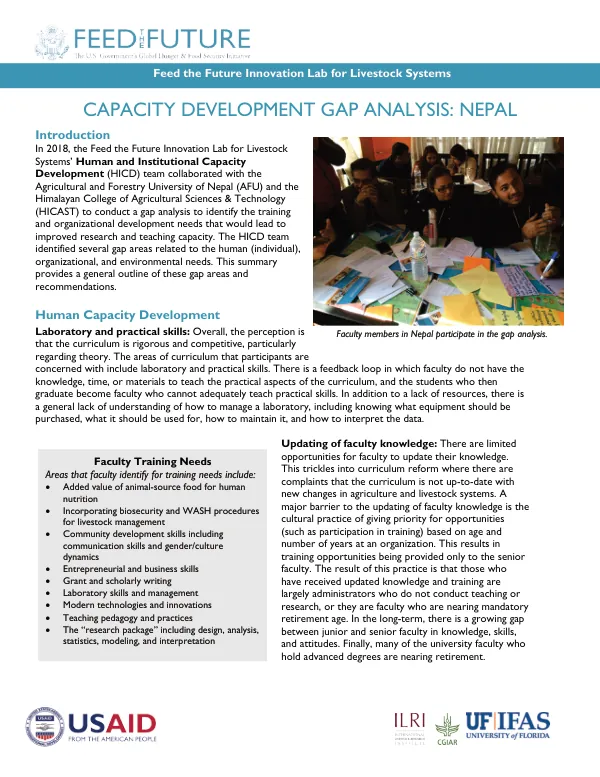 2018
2018USAID DEC
Feed the Future Innovation Lab for Livestock Systems Faculty Training Needs
Open record