USAID DEC
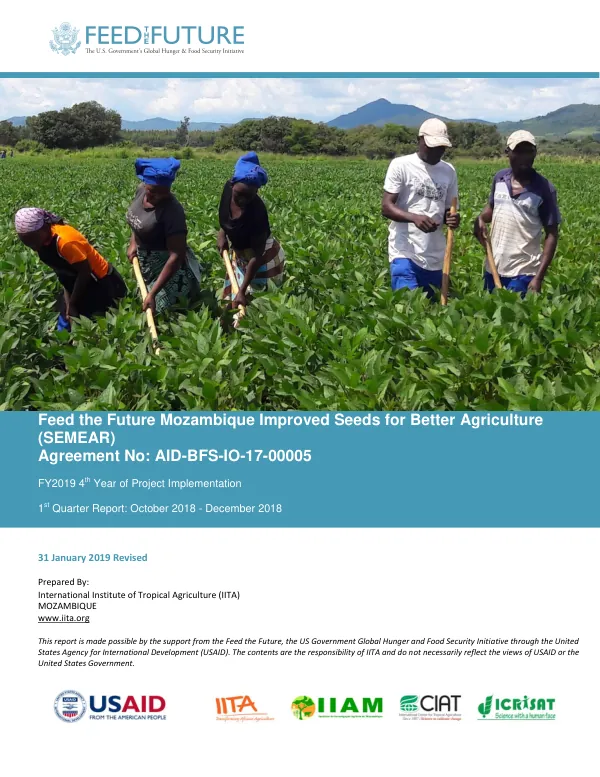
Feed the Future Mozambique Improved Seeds for Better Agriculture (SEMEAR) 1st Quarter Report: October 2018 – December 2018
Sign inINTERNATIONAL INSTITUTE OF TROPICAL AGRICULTURE
Feed the Future Mozambique Improved Seeds for Better Agriculture (SEMEAR) 1st Quarter Report: October 2018 – December 2018
The Feed the Future Mozambique Improved Seeds for Better Agriculture (SEMEAR) project is a five-year initiative that aims to improve the production and supply of improved seeds of various crops, including common bean, cowpea, groundnut, pigeon pea, sesame, and soybean.
2019 · 29 pages
Sign in to readA free account is required to download.
Abstract
The project is implemented in four provinces in Mozambique, including Nampula, Zambézia, Manica, and Tete, and focuses on the Feed-the-Future Zone of Influence (FtF ZOI). The project has three main objectives: to increase the production and supply of improved seeds, to scale up and enhance the adoption of improved varieties and best management practices, and to enhance the policy dialogue on seed and supply. To achieve these objectives, the project is implementing various activities, including the establishment of breeder/pre-basic and basic seed production, certified seed production, and seed distribution and sales. During the first quarter of FY19, the project made significant progress in achieving its objectives. The project consortium partners planted 6.2 ha of breeder/pre-basic and 83.8 ha of basic seed fields across four of the promoted crops, including common bean, groundnut, pigeon pea, and soybean. The project also supported partners to produce certified seed by supplying seeds and providing technical advice. In addition, the project established 311 variety and input demonstration plots across the FtF ZOI, which are used to train farmers, for field days, and to showcase the potential of the technologies. Soybean is the first crop to be promoted by the project, and an estimated 635 ha of certified seed area was planted by partners during the first quarter. The project also made concerted efforts to increase female participation in its activities through targeted training, demonstration, and contribution of improved seeds and other inputs to female-hosted plots. The project's performance indicators show that 27 t of certified seed was sold to seed companies, agro-dealers, farmers associations, and community seed producers during the first quarter. This quantity of seed is expected to plant 690 ha. The project also collected FY19 first quarter data from partners and beneficiaries to assess its performance and impacts. The project's collaboration with other donor projects is also an essential aspect of its implementation. The project is working with other projects, such as the Resilient Agriculture and Market Activity (RAMA) and the Feed the Future Innovations for Agriculture Activity (FtF Inov), to achieve its objectives. The project's administrative and financial information is also an essential aspect of its implementation. The project's budget for the first quarter was US$1.4 million, and the project's financial information is presented in the report. The project's evaluation and assessment are also essential aspects of its implementation. The project's evaluation and assessment are conducted quarterly to assess its performance and impacts. The project's evaluation and assessment are also used to identify areas for improvement and to make recommendations for future implementation. The project's gender issues and gender issues in SEMEAR implementation are also essential aspects of its implementation. The project is making concerted efforts to increase female participation in its activities through targeted training, demonstration, and contribution of improved seeds and other inputs to female-hosted plots. The project's environmental monitoring and mitigation plan is also an essential aspect of its implementation. The project is implementing measures to mitigate the environmental impacts of its activities, including the use of conservation agriculture and the promotion of sustainable agricultural practices. The project's communications and farmers' outreach are also essential aspects of its implementation. The project is conducting various activities to communicate its objectives and results to stakeholders, including the establishment of a project website and the use of social media. The project's major implementation issues are also essential aspects of its implementation. The project is facing various challenges, including the lack of infrastructure and the limited availability of improved seeds. The project is working to address these challenges through the implementation of various activities, including the establishment of breeder/pre-basic and basic seed production and the promotion of conservation agriculture. The project's key activities planned for the next quarter are also essential aspects of its implementation. The project is planning to establish 200 ha of breeder/pre-basic and 500 ha of basic seed fields across four of the promoted crops, including common bean, groundnut, pigeon pea, and soybean. The project is also planning to support partners to produce certified seed by supplying seeds and providing technical advice.
Related documents