USAID DEC
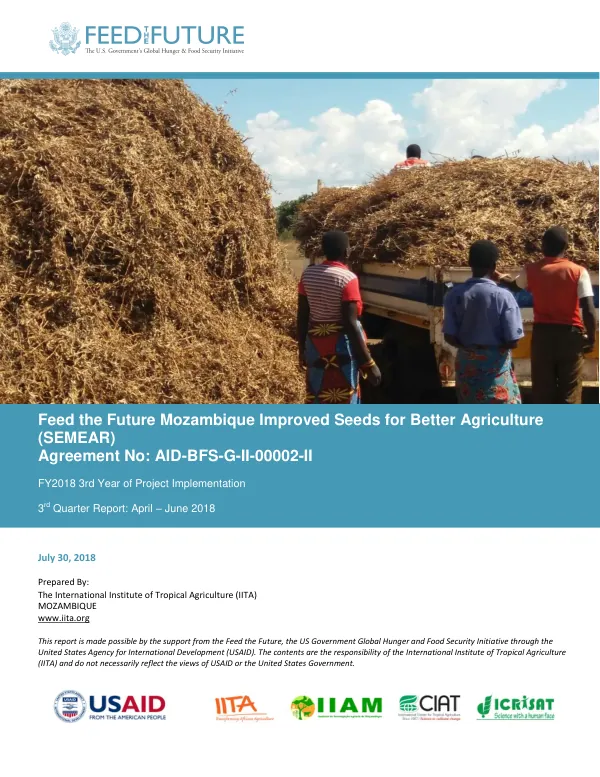
Feed the Future Mozambique Improved Seeds for Better Agriculture (SEMEAR) 3rd Year Third Quarter Report: April – June 2018
Sign inFEED THE FUTURE
Feed the Future Mozambique Improved Seeds for Better Agriculture (SEMEAR) 3rd Year Third Quarter Report: April – June 2018
The Feed the Future Mozambique Improved Seeds for Better Agriculture (SEMEAR) project is a five-year initiative implemented by the International Institute of Tropical Agriculture (IITA) in Mozambique.
2018 · 30 pages
Sign in to readA free account is required to download.
Abstract
The project aims to increase the production and supply of breeder, pre-basic, basic, and certified seeds of common beans, cowpea, groundnut, pigeon pea, sesame, and soybean in the major Feed the Future Zone of Influence (FTF ZOI) and strengthen the national seed systems. The project's geographic focus is on Nampula, Zambézia, Manica, and Tete provinces, covering eight districts in Nampula, three districts in Zambézia, three districts in Manica, and three districts in Tete. The project's objectives are to increase the production and supply of improved seeds, scale up and enhance the adoption of improved varieties and best management practices, and enhance national policy dialogue on seed and fertilizer supply. During the third quarter of FY2018, the project's main activities focused on late season weed, insect, and disease control, field inspections and certification, farmers' training, organizing field days, harvesting, and post-harvest management. The project established 37 ha of breeder/pre-basic seed and 198 ha of basic seed of the six crops being promoted. Harvesting of these fields started around the end of April, and most of the harvesting operations ended by June. The project expects to harvest about 188 tons of seed, which is estimated to plant 5,081 ha during the next cropping season. On-going activities include threshing, cleaning, and sorting out seeds, seed treatment with chemicals, and packaging for storage. About 74 tons of early generation seeds across the six crops were cleaned and stored by the end of the third quarter. The project also supplied 34 tons of basic seeds from last year's harvest to seed companies and seed producers, resulting in 901 hectares of land planted. The project supported about 165 individuals, 62 farmers' associations, and 10 seed companies and NGOs to produce certified seeds through training and field days to share information and strengthen capacities. The project worked with the Seed Inspection Unit to inspect and certify 195 ha of certified seed fields by the end of the third quarter. Partners also started harvesting their crops around the end of April and are currently undertaking post-harvest management activities.