DAI GLOBAL, LLC
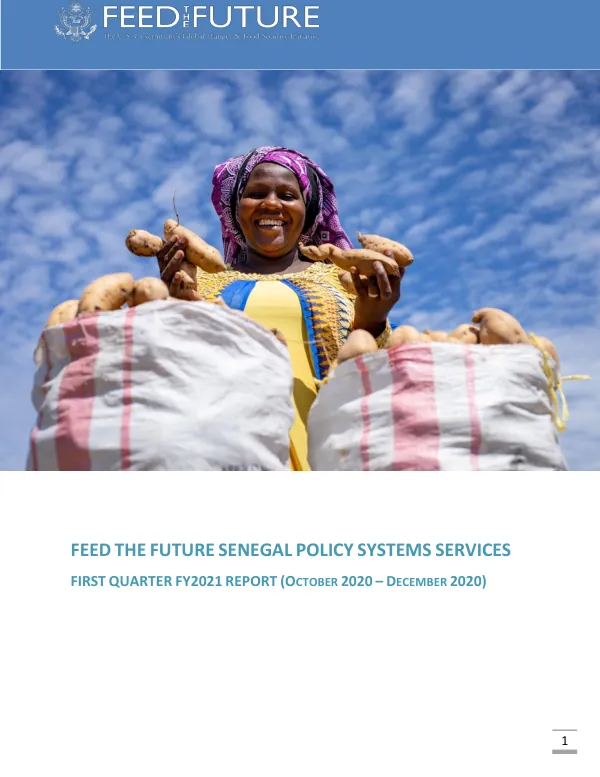
Feed the Future Senegal Policy Systems Services First Quarter FY2021 Report
The Feed the Future Senegal Policy Systems Services Activity aims to strengthen Senegal's agricultural and food policy systems by working with the Government of Senegal, the Senegalese private sector, and civil society to create an enabling environment that contributes to accelerated and inclusive growth.
2021 · 14 pages
Sign in to readA free account is required to download.
Abstract
The Activity is implemented by a consortium led by DAI in partnership with IPAR, a Senegalese policy think tank. The project team held an annual work plan design workshop from November 9-11, 2020, at Somone, to develop the first draft of its FY21 work plan and to strengthen the team spirit within members of the project Activity unit. The IPAR leadership participated in the retreat, contributing to greater ownership and stronger partnership between DAI and IPAR. The project team agreed to consider the following working guidelines to develop a realistic and effective FY21 work plan: start with a situational analysis/stocktaking of existing reforms and policies; build the work plan on the government's flagship reforms and priorities; identify windows of opportunity for low-hanging fruits; identify strategic partners; be realistic, keeping in mind that reforms are often time-consuming and require consensus; and find synergies with other USAID projects. A first draft of the FY21 annual work plan was produced, refined, and shared with the Mission. Following USAID's comments on the first draft of the work plan and building on preliminary data from visits to strategic partners, the program team held a second workshop on December 7-8, 2020, in Saly to improve the annual work plan and the AMELP, and resubmit it to the Mission. The project's COP and DCOP met with several key ministries, including the Ministère de l'agriculture et de l'équipement rural (MAER), Ministère de l'élevage et de la production animale (MEPA), Ministère de l'économie du plan et de la coopération (MEPC), and Ministère de la microfinance et de l'économie sociale et solidaire (MMESS). These meetings provided an opportunity to present the Policy Systems Services (PSS) project and lay the groundwork for formulating requests for support from these strategic public partners. Visits also included the Bureau opérationnel de suivi du PSE (BOS/PSE), the Directorate of analysis, forecasting and agricultural statistics (DAPSA), the General Directorate of Planning and Economic Policies (DGPPE), and the National Council for the Development of Nutrition (CNDN) former Unit for the fight against malnutrition (CLM). The partnership between DAI and IPAR is now fully executed, and IPAR staff is fully onboard. IPAR senior staff attended the first PSS project team retreat held in November to design the first draft of FY21 annual work plan. In December, the PSS program staff attended IPAR annual work plan review and planning. IPAR has offered their office space to the PSS team while PSS continues to finalize its office and working arrangements. The PSS team will use IPAR's office under certain conditions to ensure the safety of all staff and will follow COVID-19 safety measures put in place by IPAR, PSS, and other relevant stakeholders. The Feed the Future Senegal Policy Systems Services Activity will engage nongovernmental organizations, consulting firms, and research institutions to deliver training, provide policy analysis support, and strengthen institutional capacity on a demand-driven basis, in response to activity needs identified during implementation. The Activity will be implemented through two components: enhancing Government of Senegal policy processes and enhancing the capacity of private sector and civil society to influence policy formulation, implementation, and impact. Key facets of the Activity's support to the policy and reform implementation will include fostering dialogue with the Government of Senegal by linking private sector and civil society stakeholders to critical high-level policy forums and strengthening stakeholder engagement in the implementation of selected projects in the second phase of the PSE's Adjusted and Accelerated Priority Action Plan (PAP 2A).
Related documents