DAI GLOBAL, LLC
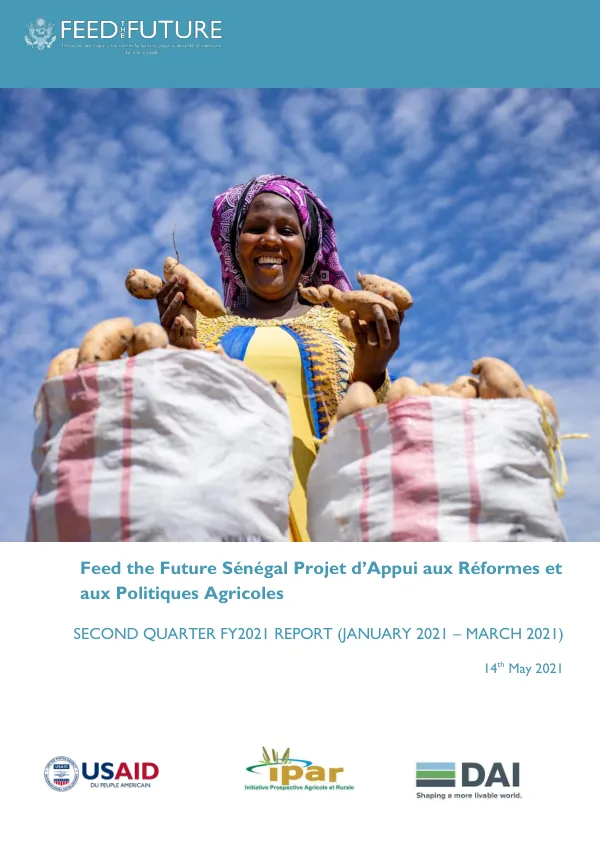
Second Quarter FY2021 Report (January 2021 – March 2021)
The Feed the Future Senegal Policy Systems Services aims to strengthen Senegal's agricultural and food policy systems by working with the Government of Senegal, the Senegalese private sector, and civil society to create an enabling environment that contributes to accelerated and inclusive growth.
2021 · 16 pages
Sign in to readA free account is required to download.
Abstract
Reforms will support the Plan d'Action Prioritaire Accéléré et Ajusté (PAP2A) of the Plan Senegal Emergent (PSE), with broad stakeholder consensus on the priorities and mutual accountability for commitments to action in support of national plans. The Activity is implemented by a consortium led by DAI in partnership with IPAR, a Senegalese policy think tank. It will engage nongovernmental organizations, consulting firms, and research institutions to deliver training, provide policy analysis support, and strengthen institutional capacity on a demand-driven basis, in response to activity needs identified during implementation. Feed the Future Senegal Policy Systems Services' interventions will be implemented through two components: Enhancing Government of Senegal policy processes by working with government stakeholders to identify needs for evidenced-based decision-making, and Enhancing the capacity of private sector and civil society to influence policy formulation, implementation, and impact by providing organizational strengthening to key private sector and civil society institutions. During the second quarter of FY21, the Feed the Future Policy Systems Services Project (PSS) continued to meet with the public sector (ministries and agencies) and began contacts with private sector and civil society organizations. The project developed a partnership process in six steps, including the very initial contact step. As of March 31, 2021, the Ministère de l'Elevage et des Productions Animales (MEPA) completed the process through step four and received an invitation letter to a joint work plan development workshop to be held in April. Similarly, four public sector organizations and four private sector and civil society organizations completed the four steps out of the five and received their letters of confirmation of partnership/support with the project. The activity overview will be structured around the following two intermediate results: IR1 Enhanced GoS Policy Processes and IR2 Enhanced Capacity of private sector and civil society to influence policy formulation, implementation, and impact. Interventions under IR1 will focus on enhancing government policy processes, including the development of a policy framework and the establishment of a policy coordination unit. Interventions under IR2 will focus on enhancing the capacity of private sector and civil society to influence policy formulation, implementation, and impact, including the provision of training and technical assistance to key private sector and civil society institutions. The project has made significant progress in establishing partnerships with key stakeholders, including government ministries, private sector organizations, and civil society groups. The project has also developed a partnership process that includes six steps, from initial contact to joint work plan development. The project's interventions are expected to contribute to accelerated and inclusive growth in Senegal by strengthening the country's agricultural and food policy systems. The Feed the Future Senegal Policy Systems Services project has identified several key performance indicators (KPIs) to measure its progress and impact. These KPIs include the number of government policies and regulations developed and implemented, the number of private sector and civil society organizations strengthened, and the level of stakeholder engagement and participation in policy formulation and implementation. The project will also conduct regular monitoring and evaluation to assess its progress and make adjustments as needed. The project's geographic focus is on Senegal, with a particular emphasis on the agricultural and food sectors. The project's timeframes are from September 28, 2020, to September 25, 2025, with a focus on the second quarter of FY21. The project's recommendations include the need for continued support for the development of the country's agricultural and food policy systems, as well as the need for increased stakeholder engagement and participation in policy formulation and implementation.
Related documents