INTERNATIONAL INSTITUTE OF TROPICAL AGRICULTURE
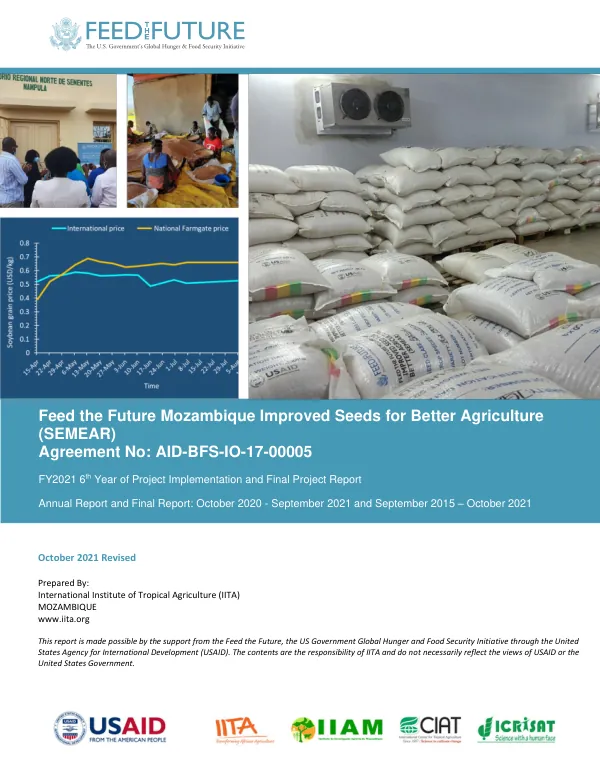
Final Report: Feed the Future Improved Seeds for Better Agriculture (SEMEAR) (2019)
The midterm evaluation of the Improved Seeds for Better Agriculture (SEMEAR) project aims to assess the effectiveness of SEMEAR's approach to increasing smallholder farmers' use of certified seeds, as well as SEMEAR's sustainability beyond USAID assistance.
2023 · 7 pages
Sign in to readA free account is required to download.
Abstract
The evaluation focuses on the project's objectives, methodology, findings, and recommendations. SEMEAR's intervention aimed at directly impacting improvement in the quantity and quality of early generation seeds. The seed development process involves several stages, including breeder's seed, pre-basic seed, basic seed, and certified seed. Breeder's seed is produced under strict controls to ensure genetic purity, while pre-basic seed is produced from breeder seed with the intention of maintaining genetic control but multiplying the seed. Basic seed is the progeny of pre-basic seed produced under conditions that ensure genetic purity and identity. Certified seed is seed multiplied from basic seed that can be commercialized and must attain certain minimum purity standards defined by law and certified. The evaluation found a general increase in early generation seed production, with breeder and pre-basic seeds annual targets met except for common beans. However, unmet demand for production of certified seed remains a problem, with basic seed production for all crops growing but its availability still perceived as a challenge by seed company managers. The number of crops reaching certified seed target has been falling during SEMEAR's life, and certified seed production was not under SEMEAR implementing consortium direct control. SEMEAR's extension strategy has had a positive impact on farmers, with 21 of 23 focus group discussions (FGDs) reporting greater knowledge and use of agricultural practices that had not been applied before. However, purchase of certified seeds remains low, with reported reasons including high costs of certified seeds, lack of sale points at district level, and the fact that farmers can multiply seeds used in demo plots without losses in yields for a few seasons. Government data shows yields in SEMEAR districts grew for most targeted crops from 2015 to 2017. The evaluation also found that 43% of trained farmers were female, and 40% of demo plot hosts were female. Women expressed a preference for scheduling trainings outside of meal preparation times. The MEL plan indicators do not cover food security, despite SEMEAR's goal statement covering income, food security, and adoption of improved technologies. The capacity of national partner (IIAM) capacities were improved as a result of SEMEAR investments in infrastructure and trainings, but basic seed production achieved only 50% of its target. Government capacity for technical assistance to farmers and to regulate the seed sector is extremely limited. The evaluation recommends that IITA develop a comprehensive exit strategy, consider providing more technical assistance to IIAM, and take actions to address constraints on the future availability of basic seeds for seed companies. USAID should consider additional capacity-building initiatives for IIAM to establish a functioning basic seed production system. SEMEAR should continue promoting demo plots as an extension strategy and reconsider geographic differences to increase trainings in Manica. The evaluation also recommends that IITA redesign the endline survey and initiate discussions with IIAM and the National Seed Authority to advocate for the release of the sesame varieties promoted by SEMEAR.