USAID
Final Report: Mass-Market Electric Motorcycle Taxis
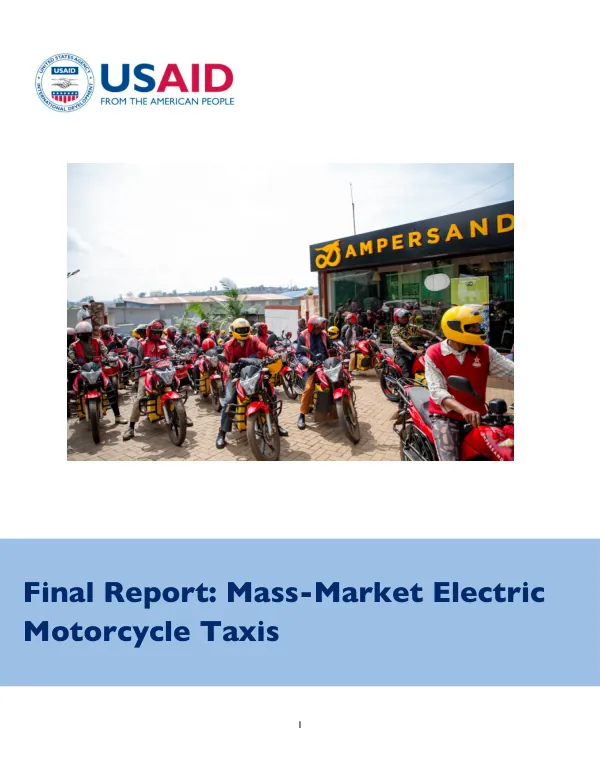
Ampersand, an energy distributor to taxi motorcycle drivers, launched commercial operations in 2019 with a pilot of 20 bikes and 3 battery swap stations in Kigali, Rwanda.
2023 · 29 pages
Sign in to readA free account is required to download.
Abstract
With the support of USAID, Ampersand has expanded its operations to over 700 bikes and 12 swap stations primarily in Kigali and a small pilot in Nairobi. The company has become the largest electric motorcycle taxi and battery swap network in East Africa. Ampersand's goals at the start of the project included demonstrating the solution's commercial viability, proving the business model, investing in research and development, and preparing for expansion into new markets and strategic partnerships. During the grant period, Ampersand developed a model to efficiently assess and expand operations, leading to significant expansion within Kigali and a launch in Nairobi. The company also developed local and national relationships with Rwandan governments to inform and support energy transitions, resulting in more supportive policies and regulations. The project has demonstrated that Ampersand can reduce pollution, improve and stabilize driver income, maintain functional and strategic partnerships, and efficiently and effectively expand. Each bike on the road reduces 5 net tons of GHG/year compared to petrol bikes, and replacing petrol with grid electricity largely supplied with geothermal and hydro renewables reduces reliance on foreign fuel. Ampersand's electric motorcycles have proven savings on energy costs and maintenance, resulting in a 35% increase in income for drivers. Ampersand has established relationships with key asset finance partners to eliminate the rent-to-own model and offer lower rates to motorcycle owners, bringing monthly payments on bikes down to cost parity with ICE vehicles. The company has also developed a regional partnership with TotalEnergies for expansion in Kenya, expediting the facilities selection and clearances process when opening a new charging station. The key objectives of the project focused on areas that Ampersand needed to prepare for growth, expansion, and scaling. Objectives included developing a software product roadmap, finance partnership strategy, charging interoperability specifications, increased customer volume, private capital, and an expansion framework. Ampersand learned the importance of serving customers' needs while building functional and flexible systems to scale and serve different markets and use cases. Ampersand designed, developed, tested, and introduced a new battery with accompanying software that is more reliable with significantly longer range than the original pilot batteries. The new improvements maintain the power needed for a demanding, high-use drive cycle while providing a low-cost LCOE. The software was improved to meet multiple needs, including better optimizing battery health through adjustable charging and accepting quick, cashless payments. The project has demonstrated that Ampersand can efficiently and effectively expand, with a successful local expansion in Rwanda and country expansion to Kenya. The company has established a strong foundation for future growth and scaling, with a proven business model, strategic partnerships, and a commitment to reducing pollution and improving community health.