USAID DEC
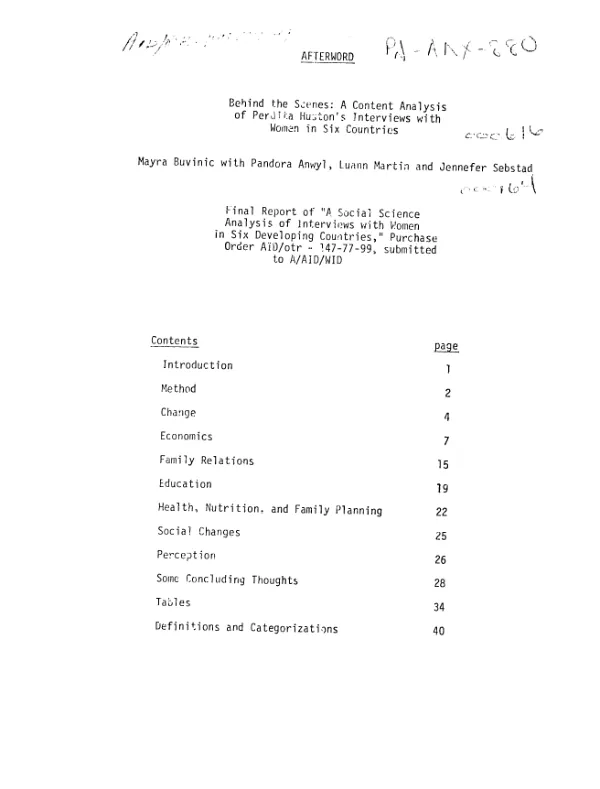
Final Report of 'A Social Science Analysis of Interviews with Women in Six Developing Countries'
Sign inTHE INTERNATIONAL CENTER FOR RESEARCH ON WOMEN
Final Report of 'A Social Science Analysis of Interviews with Women in Six Developing Countries'
The agricultural development initiative in agricultural development initiative in Eastern Province identified soil and limited market access as challenges.
2010 · 49 pages
Sign in to readA free account is required to download.
Abstract
Over 2,500 farmers received training in sustainable agriculture practices during the first year, with demonstration plots showing yield improvements of 60% when applying the recommended practices. Behind the scenes, a content analysis of Perdita Huston's interviews with women in six countries aimed to reconstruct and describe the background information behind individual portraits. The analysis used a systematic analysis of transcripts to find themes and concerns expressed by the typical woman. The main findings complemented Huston's recollections by going behind the scenes and exploring what women said and did not say during the interviews. The content analysis method used was a modified version of the standard method, where categories and subcategories were defined after familiarizing themselves with the materials. The analysis found that women perceived change to have been both beneficial and detrimental. According to a rural Mexican woman, "Despite the progress, women are still not better off." A remark from a rural woman in Sri Lanka captures the dual nature of change: "Our land got distributed, but now our portion is small. We are not living a happy life." The analysis rated statements as positive, negative, or neutral, with a score of +1 for positive statements, -1 for negative statements, and zero for neutral statements. The final score was the sum of the two ratings divided by two. The Pearson Moment Correlation Coefficient showed a high degree of agreement between the judges, indicating that the change measure was reliable for the population analyzed. The analysis found that women perceived change in various areas, including education, health, and social participation. Women found changes in these areas to be both positive and negative, with some viewing them as beneficial and others viewing them as detrimental. The analysis highlighted the complexity of change and its impact on women's lives. The agricultural development initiative in Eastern Province implemented three key interventions: farmer training programs, infrastructure development, and market linkage facilitation. Over 2,500 farmers received training in sustainable agriculture practices during the first year, with demonstration plots showing yield improvements of 60% when applying the recommended practices. The analysis found that women perceived change to have been both beneficial and detrimental. According to a rural Mexican woman, "Despite the progress, women are still not better off." A remark from a rural woman in Sri Lanka captures the dual nature of change: "Our land got distributed, but now our portion is small. We are not living a happy life."