USAID DEC
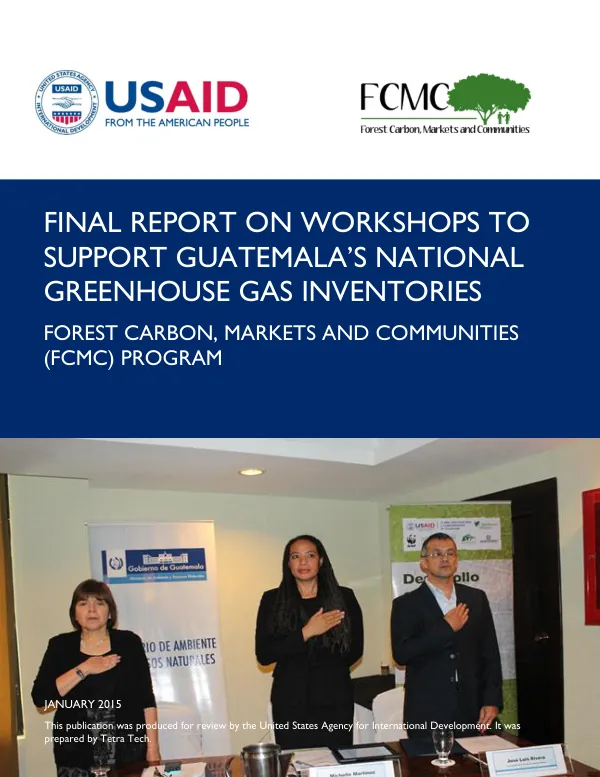
Final Report on Workshops to Support Guatemala’s National Greenhouse Gas Inventories Forest Carbon, Markets and Communities (FCMC) Program
Sign inTETRA TECH
Final Report on Workshops to Support Guatemala’s National Greenhouse Gas Inventories Forest Carbon, Markets and Communities (FCMC) Program
The Forest Carbon, Markets and Communities (FCMC) Program of the United States Agency for International Development (USAID) launched a series of workshops in Guatemala to support the development of National Greenhouse Gas (GHG) Inventories.
2015 · 50 pages
Sign in to readA free account is required to download.
Abstract
The workshops took place between July and November 2014 and were developed in collaboration with the Government of Guatemala, under the leadership of the Ministry of Environment and Natural Resources (MARN), and with technical support from FCMC and the Climate, Nature and Communities in Guatemala (CNCG) Program. The workshops aimed to strengthen the capabilities of the Government of Guatemala to develop GHG inventories for the sectors required by the National Communications, including Energy, Industrial Processes, Agriculture, Land Use, Land-Use Change, and Forestry (LULUCF), and Waste. The development of GHG inventories is a critical component of Guatemala's Low Emissions Development Strategy (LEDS) and is necessary for the country to meet its international commitments under the United Nations Framework Convention on Climate Change (UNFCCC). The workshops were designed to provide training on GHG inventories and to support the development of GHG emission inventories for the sectors mentioned above. The training was provided by a team of instructors who were selected for their expertise in GHG inventories and their ability to communicate complex technical information in a clear and concise manner. The workshops were attended by representatives from various government agencies, including MARN, the Ministry of Agriculture, and the National Institute of Statistics. The participants were provided with training on the methodologies and tools required to develop GHG inventories, including the use of Geographic Information Systems (GIS) and the Good Practice Guidance (GPG) for LULUCF. The results of the workshops were positive, with participants indicating that they had gained a better understanding of the methodologies and tools required to develop GHG inventories. The participants also identified challenges and opportunities for priority sectors, including the need for more data and the importance of engaging with stakeholders. Based on the outcomes of the workshops, the following key messages were identified to achieve national GHG emissions inventories that meet the requirements of the UNFCCC and are a solid component of policies and actions within a Low Emissions Development Strategy: 1. The development of GHG inventories is a critical component of Guatemala's Low Emissions Development Strategy (LEDS) and is necessary for the country to meet its international commitments under the UNFCCC. 2. The Government of Guatemala has a clear mandate to develop GHG inventories, with MARN being responsible for the National GHG Inventory and the development of climate change scenarios. 3. The development of GHG inventories requires a collaborative effort between government agencies, civil society, and the private sector. 4. The use of methodologies and tools, such as GIS and GPG, is essential for the development of accurate and reliable GHG inventories. 5. The engagement of stakeholders, including local communities and indigenous peoples, is critical for the development of GHG inventories that are accurate and representative of the country's emissions. 6. The development of GHG inventories should be integrated into the country's planning and budgeting processes to ensure that it is a priority and receives the necessary resources. The development of GHG inventories is a critical component of Guatemala's Low Emissions Development Strategy (LEDS) and is necessary for the country to meet its international commitments under the UNFCCC. The workshops provided a platform for the Government of Guatemala to develop the necessary capacity to develop GHG inventories and to engage with stakeholders in the process. The key messages identified from the workshops provide a roadmap for the development of GHG inventories in Guatemala and highlight the importance of collaboration, capacity building, and stakeholder engagement.