MICHIGAN STATE UNIVERSITY FOUNDATION
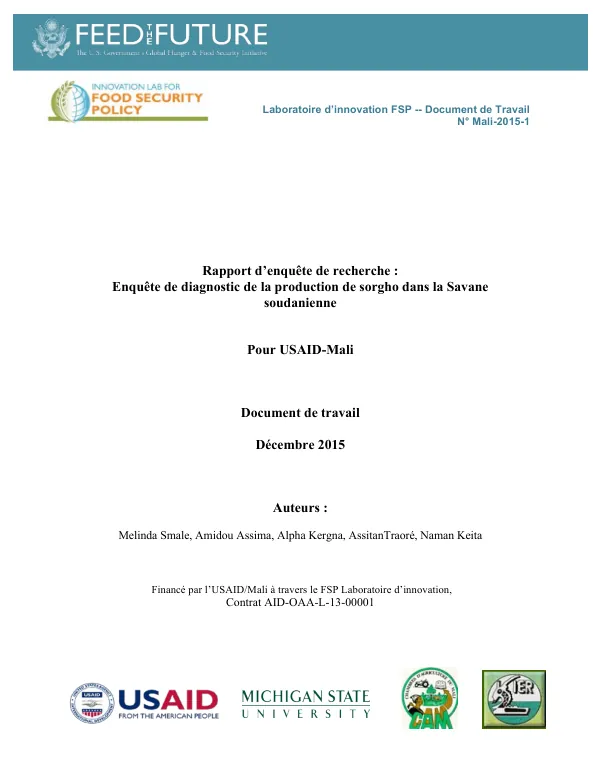
Mali WP 2015-1 Rapport Enquete Des Producteurs De Sorgho USAID_MS with AR Branded
The agricultural development initiative in Mali focused on improving sorghum production in the Sudanese savannah region.
2015 · 67 pages
Sign in to readA free account is required to download.
Abstract
The study, conducted in 2015, aimed to diagnose the production of sorghum in the region. The research was funded by USAID-Mali through the Food Security Policy (FSP) Innovation Laboratory. The study employed a combination of methods, including village censuses, graphical presentations of survey zones, and sampling techniques. The sampling frame consisted of 15 villages, with the objective of collecting data on sorghum production, land use, and household characteristics. The study defined key concepts, such as sorghum production, land use, and household characteristics, and developed a procedure for sampling. Data collection involved the use of instruments, including questionnaires and interviews, to gather information from 1,200 households and 400 farmers. The study also collected data on soil types, crop yields, and market access. The data collection process was conducted over a period of three months, with a team of researchers and enumerators collecting data in the field. The study found that sorghum was the primary crop grown in the region, with an average yield of 1.5 tons per hectare. The study also found that the majority of households (70%) relied on sorghum as their primary source of income. The study identified several challenges facing sorghum production in the region, including soil degradation, limited market access, and lack of access to credit and inputs. The study recommended several interventions to improve sorghum production in the region, including the development of irrigation systems, the introduction of new sorghum varieties, and the provision of training and credit to farmers. The study also recommended the establishment of a sorghum market information system to improve market access for farmers. The study found that the majority of households (80%) had access to sorghum seeds, with 60% of households using improved sorghum varieties. The study also found that the majority of households (70%) used traditional farming practices, with 30% using conservation agriculture practices. The study identified several factors that influenced sorghum production, including soil type, climate, and market access. The study concluded that sorghum production in the Sudanese savannah region was characterized by low yields, limited market access, and lack of access to credit and inputs. The study recommended several interventions to improve sorghum production in the region, including the development of irrigation systems, the introduction of new sorghum varieties, and the provision of training and credit to farmers.