USAID DEC
Financial Access for Investing in the Development of Afghanistan (FAIDA) Annual Report 2014
Sign inCHEMONICS
Financial Access for Investing in the Development of Afghanistan (FAIDA) Annual Report 2014
The Financial Access for Investing in the Development of Afghanistan (FAIDA) program assists the Government of the Islamic Republic of Afghanistan and the private sector in developing the financial sector.
2014 · 46 pages
Sign in to readA free account is required to download.
Abstract
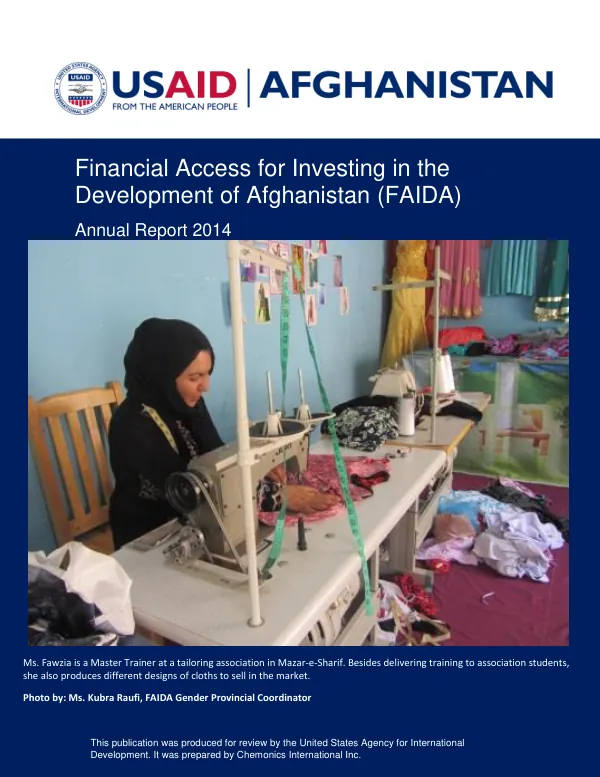
FAIDA helps USAID's Afghan partners in building capacity to deliver finance where it can be used most effectively, and in developing a legal framework and market infrastructure in which financial sector institutions and their business partners create value that provides growth and employment opportunities for all Afghans. FAIDA provides technical assistance to Afghanistan's mobile network operators to introduce innovative mobile money products and services. It supports initiatives designed to support a sustainable, commercially viable, agribusiness-based economy as the best way to achieve long-term stability, security, and enduring peace in Southern Afghanistan. FAIDA also directly assists Afghan women entrepreneurs by providing specially targeted business development trainings to enable them to gain access to financing and opportunities for economic and professional growth. The program is divided into several components, including the Enterprises Component, Banking Capacity Component, Regulatory Component, Better Than Cash Component, and Gender Mainstreaming Unit. The Enterprises Component focuses on supporting the growth of micro, small, and medium-sized enterprises (MSMEs) through business development training, access to finance, and market linkage facilitation. The Banking Capacity Component aims to improve the capacity of commercial banks to provide financial services to MSMEs and individuals. The Regulatory Component works with the Central Bank of Afghanistan to develop and implement policies and regulations that support the growth of the financial sector. The Better Than Cash Component focuses on promoting the use of electronic payments and reducing the use of cash in the economy. The Gender Mainstreaming Unit works to ensure that women's needs and perspectives are integrated into all aspects of the program. In 2014, FAIDA achieved several key results, including the establishment of 15 new microfinance institutions, the provision of business development training to over 10,000 entrepreneurs, and the facilitation of over $10 million in loans to MSMEs. The program also supported the development of a new payment system, which enabled the transfer of funds electronically across the country. FAIDA's work has had a positive impact on the Afghan economy, with the program supporting the growth of MSMEs and improving access to finance for women and other underserved groups. The program's focus on promoting electronic payments has also helped to reduce the use of cash in the economy, making it easier and safer for people to conduct financial transactions.