USAID DEC
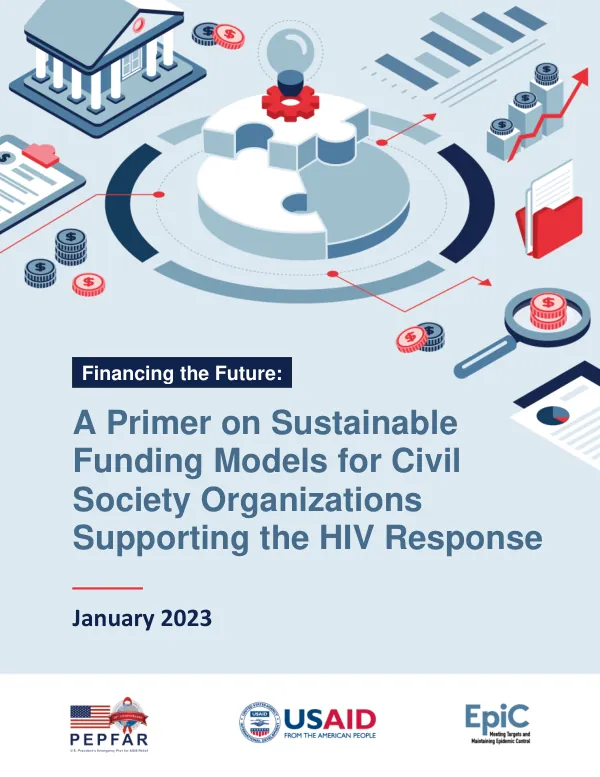
Financing the Future: A Primer on Sustainable Funding Models for Civil Society Organizations Supporting the HIV Response
Sign inFHI 360
Financing the Future: A Primer on Sustainable Funding Models for Civil Society Organizations Supporting the HIV Response
Sustainable financing for civil society organizations (CSOs) is crucial in delivering HIV prevention, care, and treatment services to vulnerable communities globally.
2023 · 36 pages
Sign in to readA free account is required to download.
Abstract
CSOs play a critical role in scaling up the global HIV response and introducing innovations across the entire HIV cascade to reach groups previously unserved, particularly key populations. The Joint United Nations Programme on HIV/AIDS (UNAIDS) recently announced a new recommendation for the amount of service delivery that should come from the CSO sector, known as the "30-60-80" targets. CSOs are often dependent on funding from international donors, which can lead to instability in services available when donors shift funding priorities and reduce funding for a particular country. Dependence on international donor funding also causes CSOs to lack the skills and understanding of the funding landscape to diversify. However, changing socioeconomic conditions in many countries indicate there may be a market for preferential or convenient services for a fee. Some CSOs have been able to leverage willingness to pay for organizational revenue through offering differentiated services for a fee or establishing social enterprises to sell a needed product or service. The HIV response is facing a significant funding gap, with an estimated US$29.3 billion needed in 2025 to end the AIDS epidemic by 2030, compared to the US$21.4 billion available globally in 2021. This funding gap is especially wide among low- and lower-middle income countries, with 44 percent more funding needed by 2025. To address this gap, CSOs need to diversify their funding sources and develop sustainable financing models. Diversifying funding can help CSOs reduce their dependence on international donors and increase their financial stability. This can be achieved by exploring different funding models, such as social enterprise, equity investment, loans and traditional bonds, impact bonds, social contract, individual donations, crowdfunding, corporate funding, and foundation funding. Each of these models has its own advantages and disadvantages, and CSOs need to carefully consider their options and choose the ones that best fit their needs and goals. In addition to diversifying funding, CSOs can also leverage their skills and expertise to develop new revenue streams. For example, they can offer differentiated services for a fee or establish social enterprises to sell a needed product or service. This can help CSOs increase their financial stability and reduce their dependence on international donors. Overall, sustainable financing is critical for CSOs to deliver HIV prevention, care, and treatment services to vulnerable communities globally. By diversifying their funding sources and developing sustainable financing models, CSOs can increase their financial stability and reduce their dependence on international donors. This will enable them to continue delivering vital services to those who need them most.
Related documents