NATIONAL PLANNING DEPARTMENT
First Training on Effective Literacy Instruction for Grades 1 & 2
The Basa Pilipinas project is a four-year initiative that began in January 2013 and will end on December 31, 2016.
2015 · 186 pages
Sign in to readA free account is required to download.
Abstract
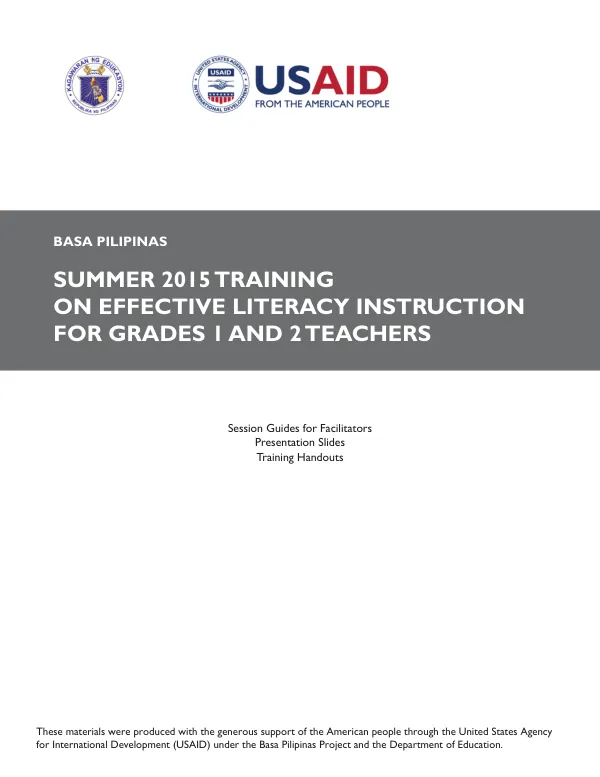
The project aims to improve reading skills for one million early grades students in the Philippines. The project's objectives include improving reading skills, providing technical assistance to the Department of Education on the language and literacy component of the K to 12 curriculum, and developing teaching and learning materials. The project's teaching and learning materials are designed to align with the K to 12 Integrated Language Arts Curriculum for the early grades. The materials include Revised Teacher's Guides, Read Alouds, and Leveled Readers, which are intended to support teachers in implementing the new curriculum. The materials are designed to promote literacy instruction that is anchored on the domains of literacy, which include 14 component skills and literacy practices. The domains of literacy are a key component of the K to 12 curriculum, and they are designed to develop learners with 21st-century skills that will prepare them for employment, entrepreneurship, or further training and education. The domains of literacy include skills such as phonemic awareness, phonics, fluency, vocabulary, and comprehension. The Basa Pilipinas project provides training for teachers on effective literacy instruction, with a focus on the K to 12 curriculum and the domains of literacy. The training includes sessions on the K to 12 Integrated Language Arts Curriculum, the domains of literacy, and the use of teaching and learning materials. The training is designed to support teachers in implementing the new curriculum and promoting literacy instruction that is anchored on the domains of literacy. The project's training program includes a pre-test to assess participants' knowledge of literacy instruction, followed by sessions on the K to 12 curriculum, the domains of literacy, and the use of teaching and learning materials. The training also includes sessions on the use of Mother Tongue as a medium of instruction and as an additional learning area from Grades 1 to 3. The project's training program is designed to support teachers in implementing the new curriculum and promoting literacy instruction that is anchored on the domains of literacy. The training is intended to improve teachers' knowledge and skills in literacy instruction, and to support them in promoting literacy development among their students. The project's training program is conducted in partnership with the Department of Education, and it is designed to support the implementation of the K to 12 curriculum. The training program is intended to promote literacy instruction that is anchored on the domains of literacy, and to support teachers in developing learners with 21st-century skills that will prepare them for employment, entrepreneurship, or further training and education. The project's training program includes a range of activities, including sessions on the K to 12 curriculum, the domains of literacy, and the use of teaching and learning materials. The training also includes sessions on the use of Mother Tongue as a medium of instruction and as an additional learning area from Grades 1 to 3. The training is designed to support teachers in implementing the new curriculum and promoting literacy instruction that is anchored on the domains of literacy. The project's training program is conducted in a range of settings, including schools and training centers. The training is designed to be flexible and adaptable to the needs of teachers and schools, and it is intended to support the implementation of the K to 12 curriculum. The training program is also designed to promote literacy instruction that is anchored on the domains of literacy, and to support teachers in developing learners with 21st-century skills that will prepare them for employment, entrepreneurship, or further training and education.
Related documents