DEVTECH SYSTEMS, INC.
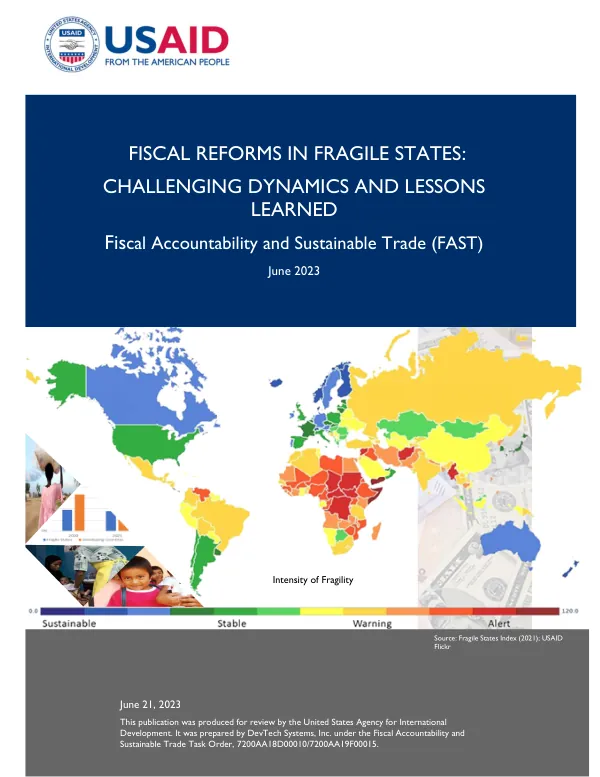
Fiscal Reforms in Fragile States: Challenging Dynamics and Lessons Learned
Fiscal Accountability and Sustainable Trade (FAST) is a program aimed at promoting fiscal reforms in fragile states.
2023 · 75 pages
Sign in to readA free account is required to download.
Abstract
The program's primary objective is to enhance the capacity of governments in fragile states to manage their finances effectively, improve domestic revenue mobilization, and strengthen public financial management (PFM) systems. The program focuses on five key areas: re-enforcing domestic revenue mobilization, improving resource prioritization, strengthening expenditure management, deepening fiscal decentralization and resource sharing, and enabling participation and giving voice. These areas are critical in addressing the challenges faced by fragile states in managing their finances, including limited revenue mobilization, poor resource allocation, and inadequate expenditure management. The program's approach is based on a comprehensive analysis of the PFM systems in five case study countries: Guatemala, Liberia, Mozambique, Nepal, and South Sudan. The analysis identified common sources or drivers of fragility, including weak institutions, limited capacity, and inadequate resources. The study also highlighted the importance of addressing these drivers to achieve sustainable fiscal reforms. The program's findings suggest that fragile states face significant challenges in mobilizing domestic revenue, with tax revenues as a percentage of GDP ranging from 10% to 20% in the five case study countries. The study also found that the COVID-19 pandemic has exacerbated these challenges, with many countries experiencing significant revenue shortfalls. To address these challenges, the program recommends a range of interventions, including improving tax policy and design, enhancing expenditure management, and deepening fiscal decentralization and resource sharing. The program also emphasizes the importance of enabling participation and giving voice to citizens, civil society organizations, and other stakeholders in the PFM process. The program's recommendations are based on a comprehensive analysis of the PFM systems in the five case study countries and are informed by international best practices and lessons learned from previous PFM reform initiatives. The program's approach is designed to be flexible and adaptable to the specific needs and contexts of each country. The program's findings and recommendations are presented in a series of annexes, including annexes on selected definitions and characteristics of fragile states, fragile states criteria, tax revenues as a percentage of GDP in fragile contexts, and principles and features of a successful tax policy and design. The program's report also includes a range of boxes, figures, and tables that provide additional information and insights on the PFM systems in the five case study countries. Overall, the FAST program's report provides a comprehensive analysis of the PFM systems in fragile states and offers a range of recommendations for improving fiscal accountability and sustainable trade in these countries. The program's approach is designed to be flexible and adaptable to the specific needs and contexts of each country, and its recommendations are informed by international best practices and lessons learned from previous PFM reform initiatives. The program's report highlights the importance of addressing the drivers of fragility, including weak institutions, limited capacity, and inadequate resources, to achieve sustainable fiscal reforms. The report also emphasizes the need for a comprehensive approach to PFM reform, one that addresses the entire PFM cycle, from revenue mobilization to expenditure management. The program's recommendations are designed to be implemented in a phased manner, with a focus on building capacity and improving PFM systems over time. The program's approach is also designed to be collaborative, with a focus on working with governments, civil society organizations, and other stakeholders to achieve sustainable fiscal reforms. The program's report provides a range of case studies and examples of good and bad practices in PFM reform, including the use of electronic government procurement systems, the establishment of county development funds, and the implementation of fiscal pacts. The report also includes a range of figures and tables that provide additional information and insights on the PFM systems in the five case study countries.