USAID
Combating Wildlife Trafficking Learning Group: What We Have Learned
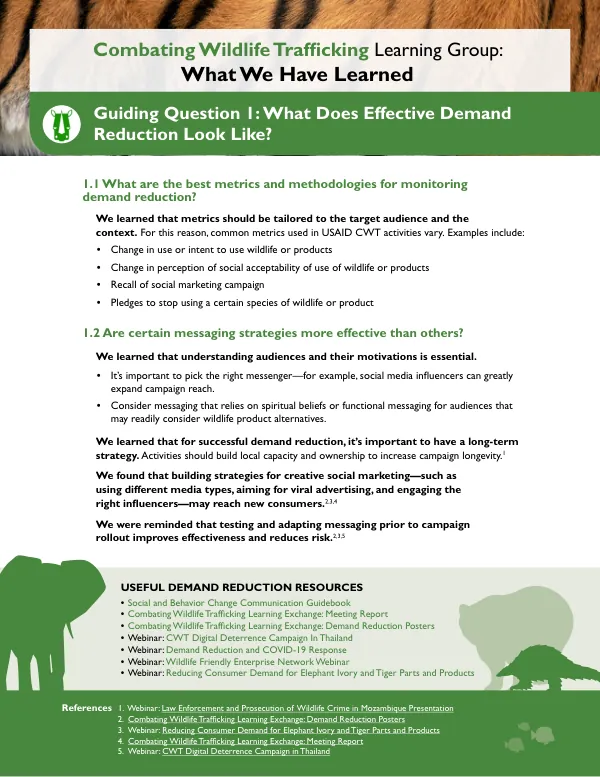
Combating Wildlife Trafficking Learning Group: What We Have Learned Effective demand reduction in combating wildlife trafficking involves understanding the target audience and context.
2021 · 7 pages
Sign in to readA free account is required to download.
Abstract
Metrics for monitoring demand reduction should be tailored to the specific audience and context, and may include changes in use or intent to use wildlife or products, changes in perception of social acceptability of use of wildlife or products, recall of social marketing campaigns, and pledges to stop using certain species of wildlife or products. For example, in Rwanda, a social marketing campaign increased recall among the target audience by 25%. Understanding audiences and their motivations is essential for effective demand reduction. Messaging strategies that rely on spiritual beliefs or functional messaging may be more effective for certain audiences. For instance, in Thailand, a campaign that emphasized the spiritual significance of elephants increased awareness and reduced demand for ivory products. Building local capacity and ownership is crucial for long-term demand reduction strategies. Activities should focus on building local capacity and ownership to increase campaign longevity. Creative social marketing strategies, such as using different media types, aiming for viral advertising, and engaging the right influencers, may reach new consumers. Testing and adapting messaging prior to campaign rollout improves effectiveness and reduces risk. For example, in East Africa, a campaign that tested different messaging strategies before rollout increased awareness and reduced demand for wildlife products by 30%. Effective law enforcement capacity building involves institutional arrangements that impact the uptake of skills and knowledge. Networking and training help law enforcement officers learn from each other and build relationships and trust. Outside experts can further increase benefits, such as embedded legal support in parks that gives frontline staff and park officials the legal aid they need and boosts morale. Creating pride and identity for the institution encourages cohesion, such as the logo for Namibia's Conservancy Rhino Ranger Incentive Program that depicts a rhino inside a human eye with the slogan "Keeping an Eye on Our Rhino." Clearly assigned roles build ownership and accountability, and an institutional culture that celebrates champions and offers incentives can encourage dedication to difficult jobs and goals. Wildlife heroes can catalyze change, potentially overcoming complicated bureaucracy, weak commitment, and corruption. Long-term, short-term, monetary, and non-monetary incentives may encourage improved performance of frontline staff. Effective CWT enforcement systems integrate the entire law enforcement chain, with a framework to support sharing intelligence and resources from enforcement through prosecution. For example, Kenya's Eyes in the Courtroom program found that collaboration among all agencies handling wildlife crime is critical to success. Effective law enforcement systems may work across national borders, such as USAID's Supporting the Policy Environment for Economic Development (SPEED+) activity that found that legal bilateral agreements and milestone-based government-to-government agreements between countries can help tackle wildlife crime, build trust, and share intelligence. Cooperation among authorities in wildlife enforcement networks (WENs) is enabled by key factors, including political will and government commitment, cultures of collaboration, learning, and communication, and technology and intelligence data-sharing across institutions. For example, the Zoological Society of London (ZSL) program in Nepal and USAID's PREPARED activity in East Africa found that high-quality intelligence is often scarce but can strategically inform operations. Successful examples of partnerships used to deliver competency-building activities include the ZSL program in Nepal, which built capacity through diverse partnerships and new skills and technologies, and the Mesa Técnica in Guatemala, which found that cross-border civil society partnerships strengthened enforcement, facilitated information exchange, and promoted collaboration on CWT. Competency-building methods and content that work best for maintaining skills and retaining staff include tailoring activities to the local context, using capacity assessments to identify needs, and conducting continuous professional development. For example, Indonesia's Wildlife Crime Unit suggests each trainee undergo four training components: initial training, first refresher, second refresher, and evaluation to complete the process. On-the-ground support and mentoring can improve success and retention, and good engagement often moves beyond traditional approaches, such as expand training to promote the values and attitudes needed for good enforcement practice.
Related documents